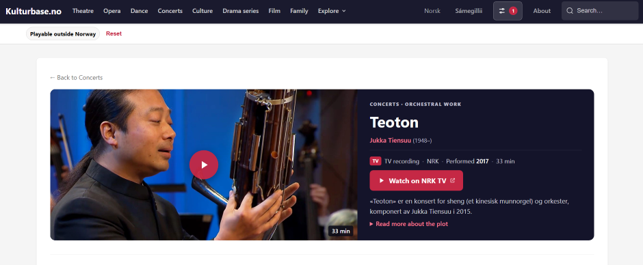
There is a recording of Jukka Tiensuu’s Teoton performed by the Norwegian Radio Orchestra. I could have listened to it without leaving home. The only obstacle was that I had no idea it existed.
I found it through Kulturbase.no, a catalogue bringing together Nordic theatre, opera and concert recordings. One discovery was enough to make me wonder how much else I was missing and how much of our shared musical culture remains hidden even when it is freely available online.
I asked the person behind the service, Stian Håklev, what had prompted him to make these recordings easier to explore. Håklev lives in Hamar, Norway, and has a doctorate in digital pedagogy. He says his own interest in the performing arts developed relatively recently.
“I have always been a reader, but I came to theatre, opera and classical music late, in my forties.” His way in was the Norwegian public broadcaster NRK’s archive of television theatre. Watching old productions led him to read plays and buy theatre tickets. Opera and concerts followed. An archive became the beginning of a new relationship with live cultural life.
That is a compelling reason to keep performances available long after their original broadcast. A production made decades ago can prompt someone to enter a theatre today. A recorded concert can introduce a composer whose music the listener will seek out again. But those encounters depend on people finding the recordings in the first place.
“The recordings were there, but they were hard to find, and even harder to see how they connected,” Håklev explains. What other performances existed of the same work? What else had its composer written? These are ordinary questions for a curious listener, yet answering them can require considerable persistence. Archives and streaming services have their own catalogues, search tools and ways of describing their contents. Following a musical interest across them means repeatedly starting again.
Håklev began building a catalogue for himself. He then expanded beyond NRK to Finland’s Yle, the Swedish and Danish public broadcasters and orchestras’ own channels. Kulturbase allows users to explore recordings by work and composer, and to filter for performances available worldwide. The recordings play at their original sources; the catalogue provides connections between them.
He was surprised by how much archival material could be accessed across Nordic borders while remaining unfamiliar to listeners in neighbouring countries. A Danish listener might never think to look for a Nielsen symphony in Yle’s archive. And I needed his catalogue to discover Tiensuu in Norway.
Our countries are close, but our cultural habits can remain decidedly national. We know the broadcasters, institutions and services around us. We have learned where to look. Beyond those familiar routes, there may be an extraordinary amount to hear, with little to alert us to its existence.
This is a peculiar kind of distance. Publishing a recording online leaves some of the work unfinished. Someone has to identify it, describe it and connect it with other performances and works. Someone has to consider how a listener might arrive without already knowing precisely what to ask for. In my case, that work determined whether the music reached me at all.
Håklev describes the arrangements behind Kulturbase simply. “I built it alone, in my spare time, and I pay for it myself.” The service has no advertising or sponsors, he says, and no affiliation with the institutions whose recordings it brings together. I am grateful that someone has undertaken this work. His account also raises a question about how much the accessibility of our shared culture depends on an individual’s curiosity, knowledge and willingness to help others find it.
Kulturbase offers a useful starting point for this issue’s exploration of music and place. Music emerges from particular surroundings, but it travels through relationships: between musicians, institutions, organisers and listeners. Those connections allow something rooted in one place to become meaningful somewhere else.
The articles that follow approach this relationship at different scales. Juha Mäki-Patola translates impressions of landscapes and seasons into ambient music. Heli Hartikainen works with the resonances of churches, an abandoned mine and the space of the body itself. In Tampere, independent jazz labels find strength in local cooperation while reaching international listeners, and the Biennale brings its hometown into dialogue with a wider musical world. In Oulu, a listener’s encounter with an unfamiliar performance changes her relationshipwith the cultural life around her.
Together, these stories ask how places shape music, how musical communities grow and how people find their way into them. Sometimes that begins with a major festival or a collaboration built over years. Sometimes it begins at home, with a recording we never knew existed.