“I’m interested in harmony as a musical component and a driving force,” says Sebastian Dumitrescu, summarising his work as a composer.
“This was true even when I was still using a set of 12 pitches. Eventually, the means and solutions afforded by this paradigm were no longer satisfactory. I developed an interest in the sound of microtonal music. It offered a way of producing harmonies that seemed very natural yet unusual.”
Whether a harmony is perceived as consonant or dissonant depends on the acoustic or harmonic series, which among other things determines how instruments sound, their essential tonal colour. Doubling the frequency of a tone produces an octave; three times the frequency is up a fifth from there; four times the frequency is up a major third, and so on. The higher up we go in the series, the more pitches, or partials, we find that do not fit into traditional 12-tone equal temperament.
“I took an interest in how individual partials in the harmonic series relate to the fundamental pitch. I also remember the moment when I learned about the 19-tone octave, where you have both C sharp and D flat between C and D, and the interval between them is the same as between C and C sharp.
“In my artistically oriented doctorate, I discuss how microtonal pitch sets can be organised along the consonance-dissonance axis, as measured with a particular equation. I use this to select harmonies depending on how pleasant or jarring I want it to be.”
.png)
Microtonal sight-reading
Historically, the tuning system used in Europe has been based on just intonation, with the intervals that form scales and chords built mainly on fifths and major thirds derived from the harmonic series (with frequency ratios of 3:2 and 5:4, respectively). Even today, choirs, string players and wind players try at least to some extent to tune their harmonies on the basis of just intonation.
Dumitrescu explains that in his music he expands this natural harmony up to the 7th and 11th partials, which correspond roughly to a minor seventh and an augmented fourth.
“My aim is the same as with just intonation: to make extended harmonies as sonorous as possible.”
Comments on his suite for vocal ensemble, Flame and Shadow: Madrigal Fragments, which is tuned to an octave divided into 31 pitches, indicate that its harmonies sound unfamiliar but not dissonant, recalling the tuning of a jazz vocal ensemble or a barbershop quartet.
“That’s the wonderful thing about the human voice. Consonant intervals and chords sound good, even though we have no way of easily pigeon-holing microtonal chords, such as ‘major’ or ‘minor’ or ‘seventh chord’.”
Vicentino Singers, who commissioned and premiered Flame and Shadow, are – true to their name – familiar with the madrigals of Renaissance composer Nicola Vicentino, who likewise worked with a 31-tone octave. They train their fine tuning for example with an app named Hexatone.
“I’ve found that you can learn through practice to identify microintervals and to imagine them,” says Dumitrescu, who also teaches microtonality at the Sibelius Academy.
“You have to marinate yourself in them through listening, repetition and memory. At some point I realised they’d become so familiar that I had to recalibrate my approach and delve deeper to find something that sounded unfamiliar.”
Dumitrescu’s doctoral recital in October 2026 included performances of Flame and Shadow and of three other microtonal works: a new piece for the Uusinta Ensemble string quartet, Arrhythmia for synthesiser and electronics played using a Lumatone keyboard, and a piece for harpsichord and Lumatone commissioned by keyboard player Matias Häkkinen.
“I draw on some of the harmonic thinking of the 15th and 16th centuries in my work, along with something from the 20th century and something from the present day. I want my music not to revel in a particular sound for an extended period of time but to move sensibly from one harmony to the next.”
.jpeg)
The history of unusual keyboards
Vicentino’s theories never made it into the mainstream of European music. It was not until the early 20th century that microtonality again became an item of interest, with composers such as Charles Ives (1874–1954) and Ivan Wyschnegradsky (1893–1979) writing piano music using quarter-tones.
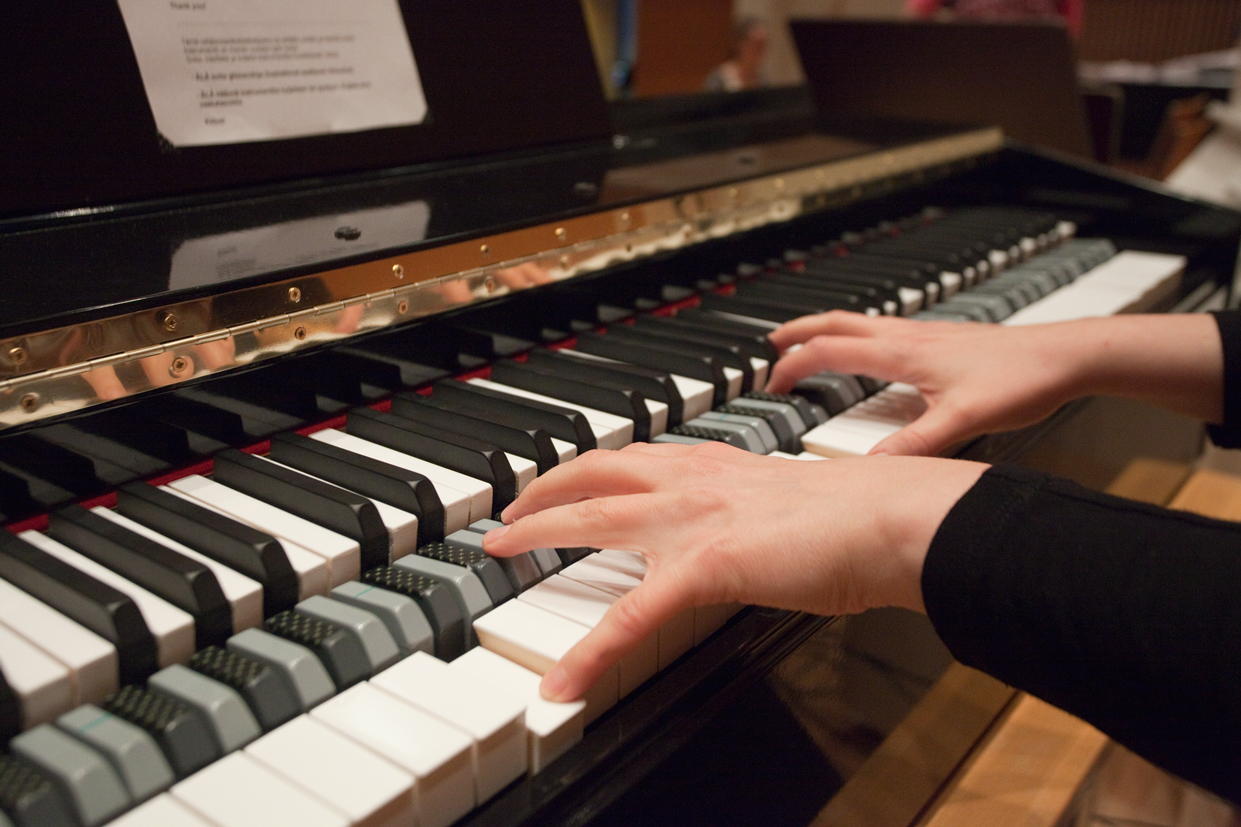
Some of their music was recently recorded by pianist Elisa Järvi, who developed a practical 24-tone piano keyboard with composer Sampo Haapamäki a decade ago. On Järvi’s quarter-tone keyboard, the traditional black keys have been cut off at the root and replaced with dark grey and light grey keys. Haapamäki’s Piano Concerto written for this keyboard won the Nordic Council Music Prize in 2020.
“In my doctorate, I explored the modern concert grand and various historical pianos. By then, I’d performed a lot of contemporary music and worked with composers. These two aspects of my career came together in the question of how the piano might be evolving next,” says Järvi.
“And in recent years we’ve come to understand that microtonal pianos have a history too.”
Accordingly, the disc In tune – tune in! goes back in time. Järvi researched the instruments that were available to Ives, Wyschnegradsky, Ivor Darreg (1917–1994) and Tui St. George Tucker (1924–2004) for their quarter-tone piano music. Their works are joined on the disc by microtonal piano music by Finnish contemporary composers Lauri Mäntysaari, Hannu Pohjannoro, Jukka Tiensuu and Juhani Nuorvala.
“The works by the older composers can be performed on my keyboard, but I couldn’t perform the works written for me on the pianos that they used. I feel that this system is easy to understand for a pianist, and you can reach all the microintervals with one hand.”
Järvi’s 24-tone keyboard is not an acoustic instrument; it is a MIDI keyboard. For the recording, Järvi’s inputs were fed into two Yamaha Disklavier grand pianos tuned a quarter-tone apart.
“There’s a microtonal symposium in Vilnius in early October where I’ll be performing by controlling two Disklaviers in this way. We’ll be able to get quite close to the experience that listeners may have had a century ago when Hans Barth performed quarter-tone music of his day on an acoustic instrument at Carnegie Hall. In January, I’ll be playing Disklaviers tuned to 22 tones per octave at the Musiikkitalo.”
Assuming other pianists find the keyboard useful, time will tell whether it would be possible to develop an acoustic version of the instrument.
“I’ve introduced some of my students who are interested in the topic to this instrument. They’re mainly composition majors. It’s an interesting question how you would teach this instrument. You can tune the keyboard to 22 or 31 tones per octave. Sometimes the educator in me thinks whether I should write up a pedagogical guide and some progressive microtonal pieces.”
Quick tuner for the piano
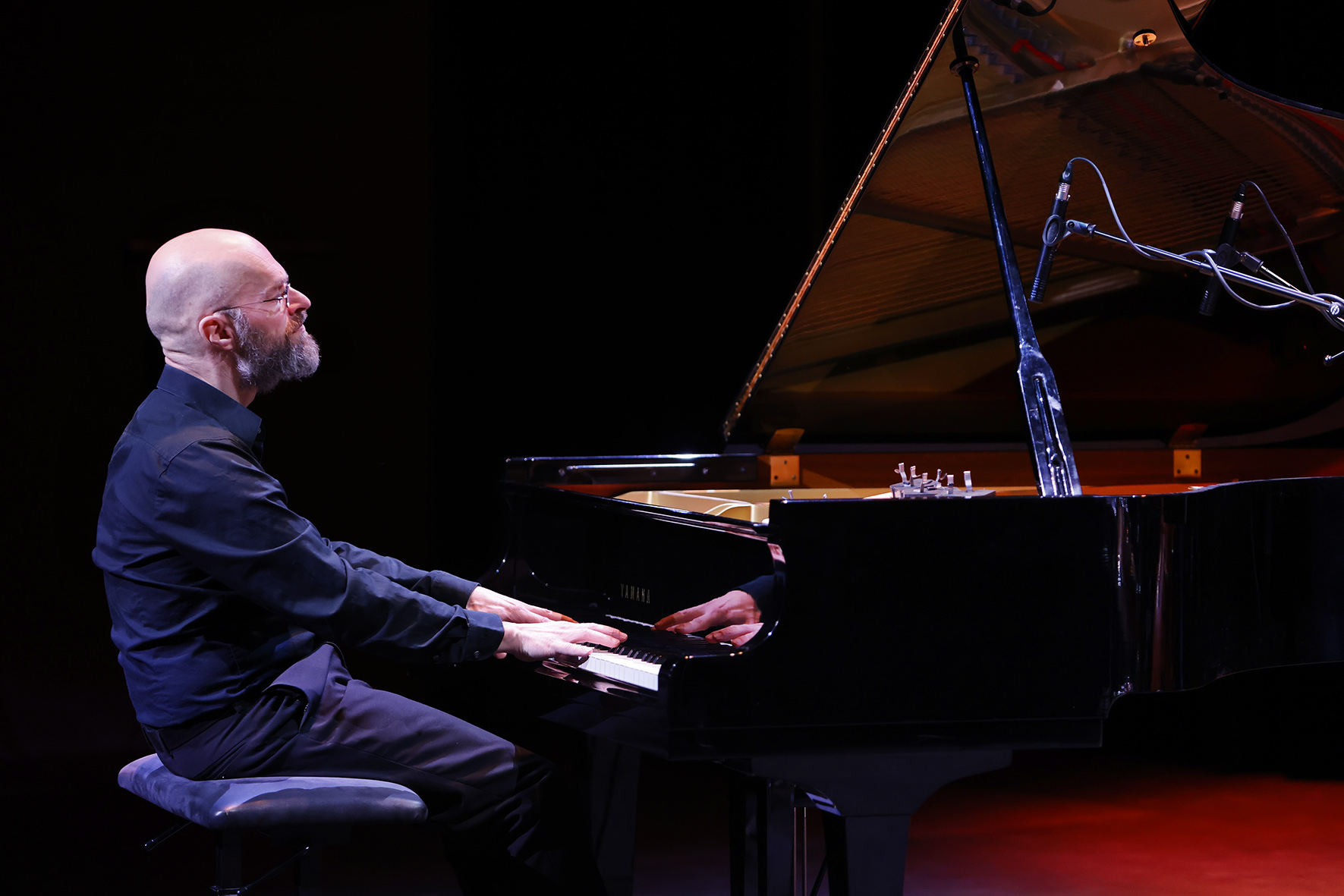
Beyond all of the above, we have to remember that there have been sounds different from Western tuning around the world for thousands of years – Indian ragas, Indonesian gamelan, the blues born out of the African diaspora, to name but a few. The maqam scales of the cultures of the Middle East have fascinated pianist and composer Kari Ikonen for several decades.
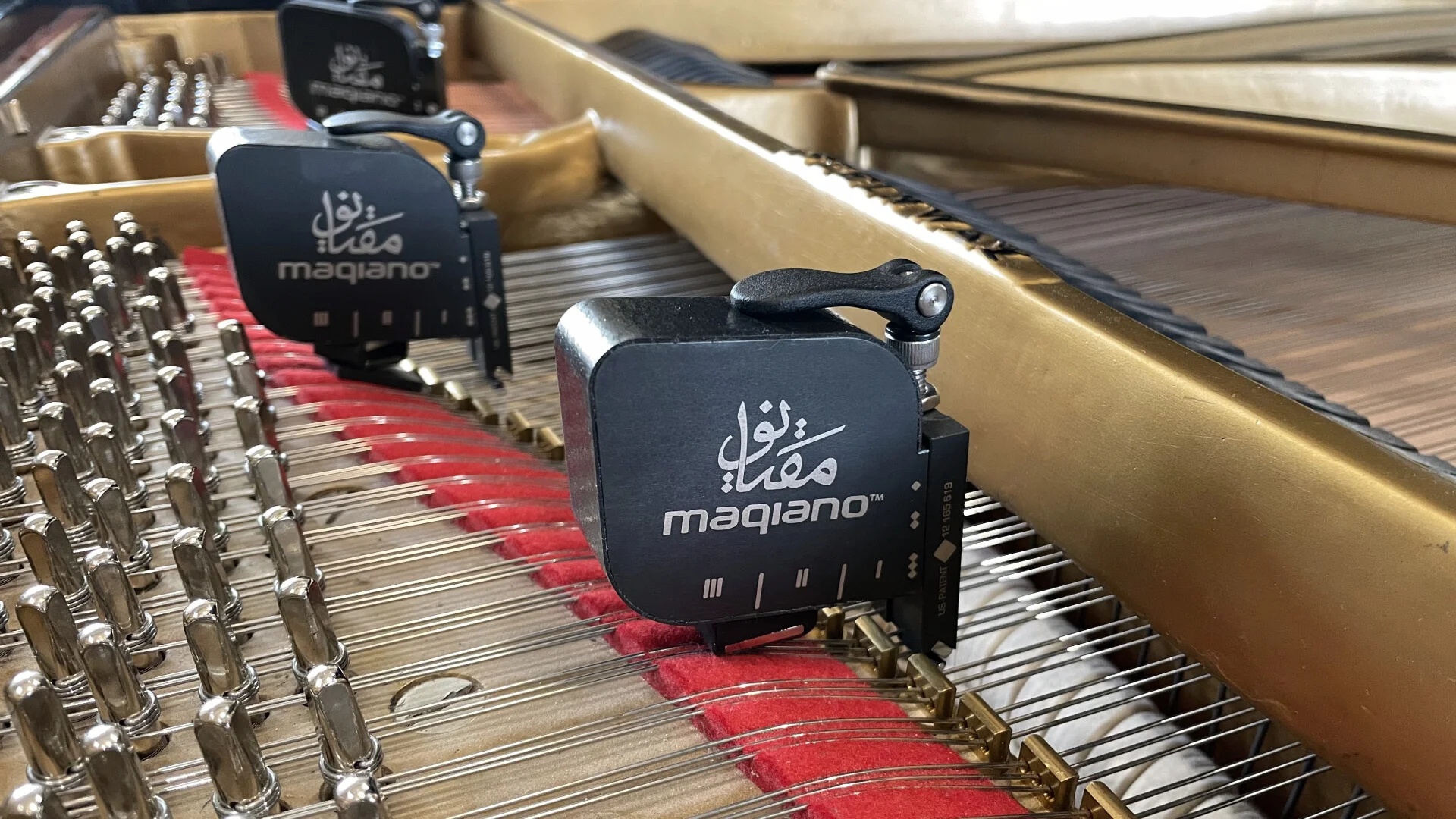
At the end of the last decade, Ikonen developed Maqiano, a portable accessory that can easily be installed and uninstalled to raise the pitch of a piano string by a variable amount. It is a narrow iron weight fitted with a rubber covering to increase friction and stability. The weight is attached to the piano string with a tiny anchor, between the tuning pin and the damper, and it works equally well on upright pianos and concert grands.
“There’s now a new version of Maqiano, where the sound is completely undistorted. Orders have come in from around Europe, the USA and Canada, in many cases from pianists from Arab or Turkish backgrounds – or else from contemporary musicians or experimental jazz geeks. Not a lot have gone to the Middle East, because acoustic pianos are quite rare there,” Ikonen explains.
He points out that keyboard players in the Middle East generally use electronic instruments with pre-programmed maqam scales.
“The Moog synthesiser is my other main instrument along with the piano. With the help of a friend, I’ve developed a pedal that allows notes on the Moog to be detuned up or down to produce microintervals on the fly.”
Ikonen has performed music tuned with Maqiano both at solo recitals and with his ensembles Silta, Wishamalii and Orchestra Nazionale della Luna in Europe, the Middle East, northern Africa, Japan and Australia. He has also begun developing microtonal scales of his own, allowing his ear to guide him to satisfying harmonies.
“I’m constantly discovering new ways to use Maqiano. Sometimes I tune a pitch quite close to the adjacent pitch, if it produces an interesting sound. I’m searching for a new language of improvisation that would involve new microtonal nuances and colours with no pre-existing systems – with rhythm leading the way, as I’m fundamentally a jazz musician. It’s a time-consuming process, but utterly fascinating.”
Quarter-tone pianos, twin-manual harpsichords and Lumatone are of interest to Ikonen as well, but there just are not enough hours in the day for everything, especially as he usually performs on a standard concert grand.
“A piano concerto using Maqiano might be interesting. I’ve been hoping that someone would write one of those. Maybe I’ll write one myself some day.”
Translation Jaakko Mäntyjärvi
Featured photo Ari Kesonen