On 4 January 1926, Jean Sibelius received a telegram from Walter Damrosch, conductor of the Symphony Society of New York. Damrosch commissioned a new symphonic poem for performance later that year, offering the Finnish composer 400 dollars for the first three performances. The work that emerged from the commission was Tapiola.
Even before the score was completed, there was uncertainty about how the title Tapiola should be rendered in English. While Sibelius was in Rome working on the composition, Aino Sibelius received a letter questioning the translation "The Wood." She responded by suggesting alternatives such as "In the Wood" or perhaps "In the Forest."
The confusion was understandable. For Finnish audiences, Tapiola evoked a rich mythology: the realm of Tapio, the ancient forest god. For most English-speaking concertgoers, however, the title conveyed little or no meaning. Helen Mobert, Publicity Director of the Symphony Society, wrote directly to Sibelius asking whether Tapiola was the name of a particular forest or simply meant "the forest." Somewhat later, Damrosch proposed an explanatory subtitle: "A wild northern forest, wherein dwell the God of the forests and his wood-nymphs." Sibelius approved.
The famous poetic text included in the first edition sought to guide listeners further:
Wide-spread they stand, the Northland's dusky forests,
Ancient, mysterious, brooding savage dreams;
Within them dwells the Forest's mighty God,
And wood-sprites in the gloom weave magic secrets.

Preparations for the American publication of Tapiola also revealed a practical complication. Because Finnish musical works did not enjoy copyright protection in the United States, Sibelius's publisher, Breitkopf & Härtel, devised a workaround. A German musician would formally "revise" the score by adding interpretative markings, a solution that was not uncommon at the time but appears rather unusual today (see the photo above). Sibelius was invited to suggest the additions himself. Breitkopf assured the composer that the revised manuscript would remain in its archives, making it impossible for readers of the printed edition to distinguish between the original score and the revisions made for copyright purposes.
The work’s first performance took place on 26 December 1926 at New York's Mecca Temple. It appeared alongside George Gershwin's Piano Concerto in F and Beethoven's Fifth Symphony. Before the performance, Damrosch painted a vivid picture for the audience, describing limitless dark-green forests, icy northern winds and ghostly woodland spirits weaving their dances among the trees.
The critics were not convinced.
Lawrence Gilman of the New York Herald Tribune admired the programme note more than the music itself. Samuel Chotzinoff, writing in The World, found the work's opening motif lacking character. Other reviewers complained that the thematic material was insufficiently distinctive and overdeveloped. Even Olin Downes, perhaps Sibelius's most influential American champion, regarded Tapiola as somewhat disappointing, a work of style rather than inspiration.
With hindsight, these reviews are striking, given the esteem in which Tapiola is now held. According to Sibelius scholar Kari Kilpeläinen, American critics began to reassess the work only after Serge Koussevitzky conducted it in Boston in 1932. Gradually, Tapiola came to be regarded as one of Sibelius's most significant orchestral works.
One aspect of Tapiola's early performance history resurfaced in the pages of Finnish Music Quarterly 35 years ago.
In 1991, FMQ published a previously unknown letter from Sibelius to the conductor Arthur Rodziński. Troubled by the absence of tempo markings in several passages of Tapiola, Rodziński wrote to the composer asking for advice on how they should be performed. Sibelius replied with detailed instructions.
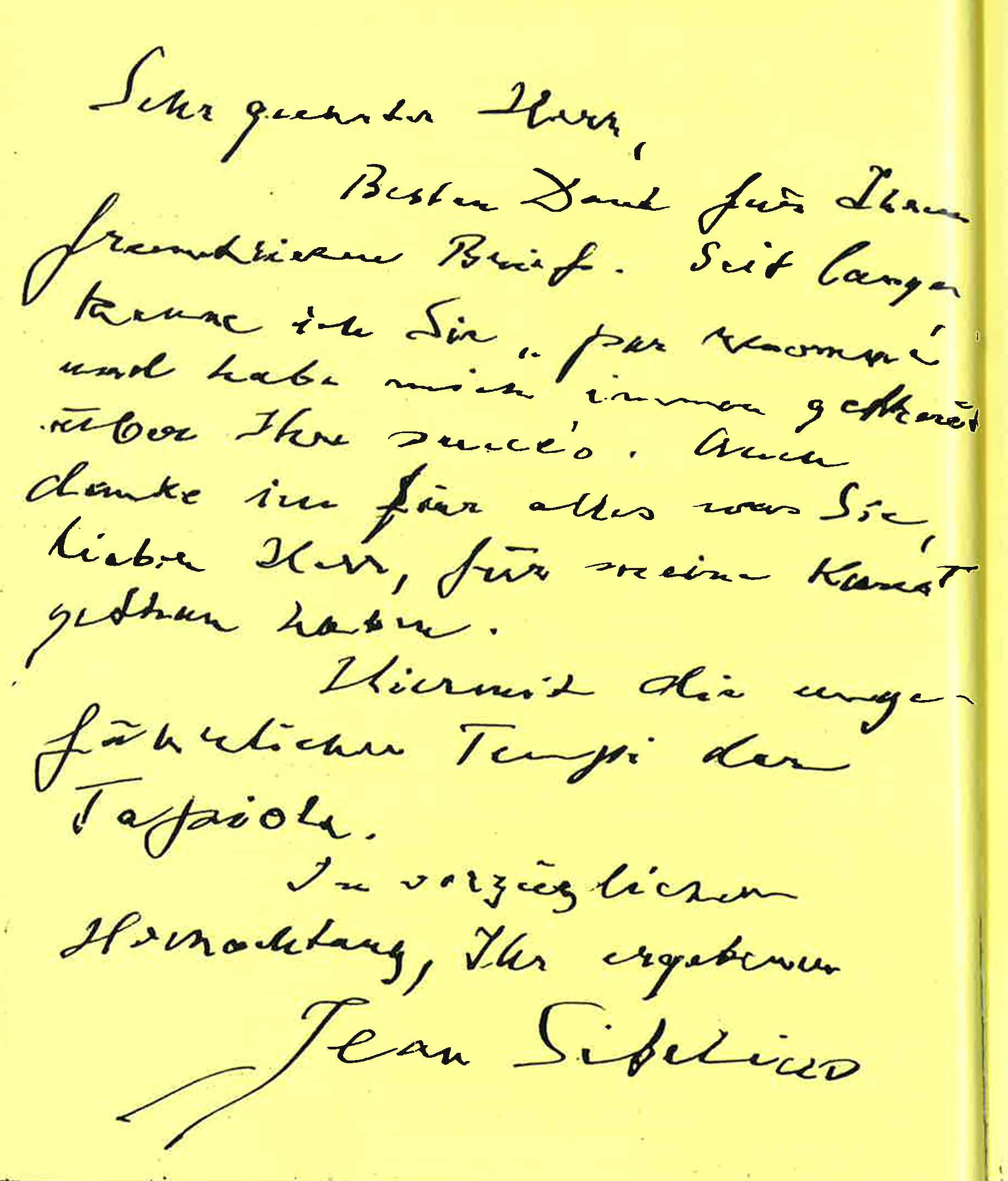
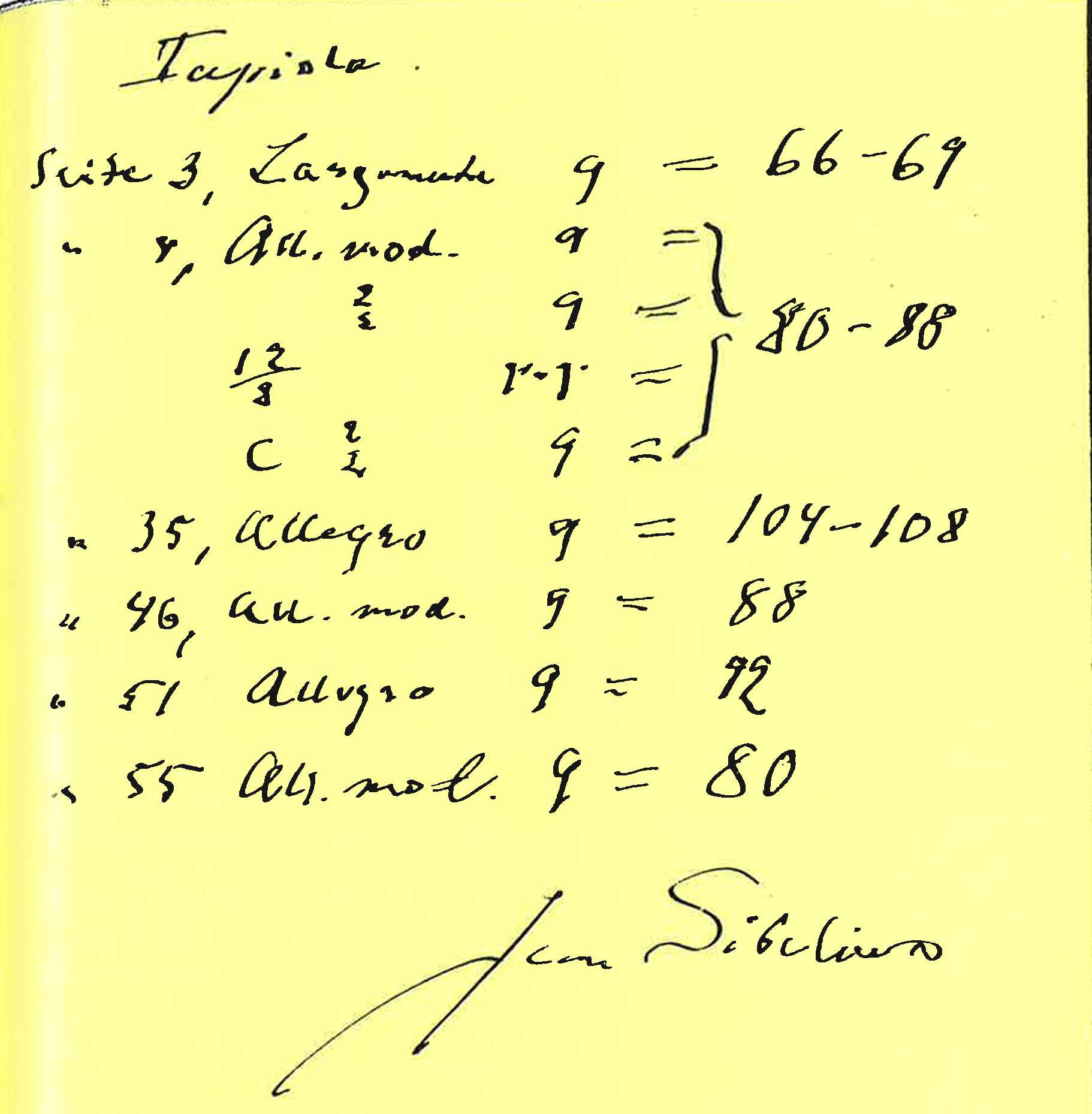
The letter, a copy of which was donated to FMQ by Rodziński's son Richard Rodziński, provides useful insight into Sibelius's views on the performance of Tapiola. It also serves as a reminder of the close connections between Sibelius and the conductors who championed his music abroad. (Rodziński conducted Tapiola in New York on 29 November 1934.)
Looking back from the perspective of both the centenary of the commission and the 35th anniversary of FMQ's publication of the Rodziński letter, the correspondence offers a small but illuminating perspective on the early life of Tapiola. It belongs to the broader story of how the work was introduced, interpreted and gradually reassessed outside Finland.
The author would like to thank John Todd from London for the inspiration for this column.