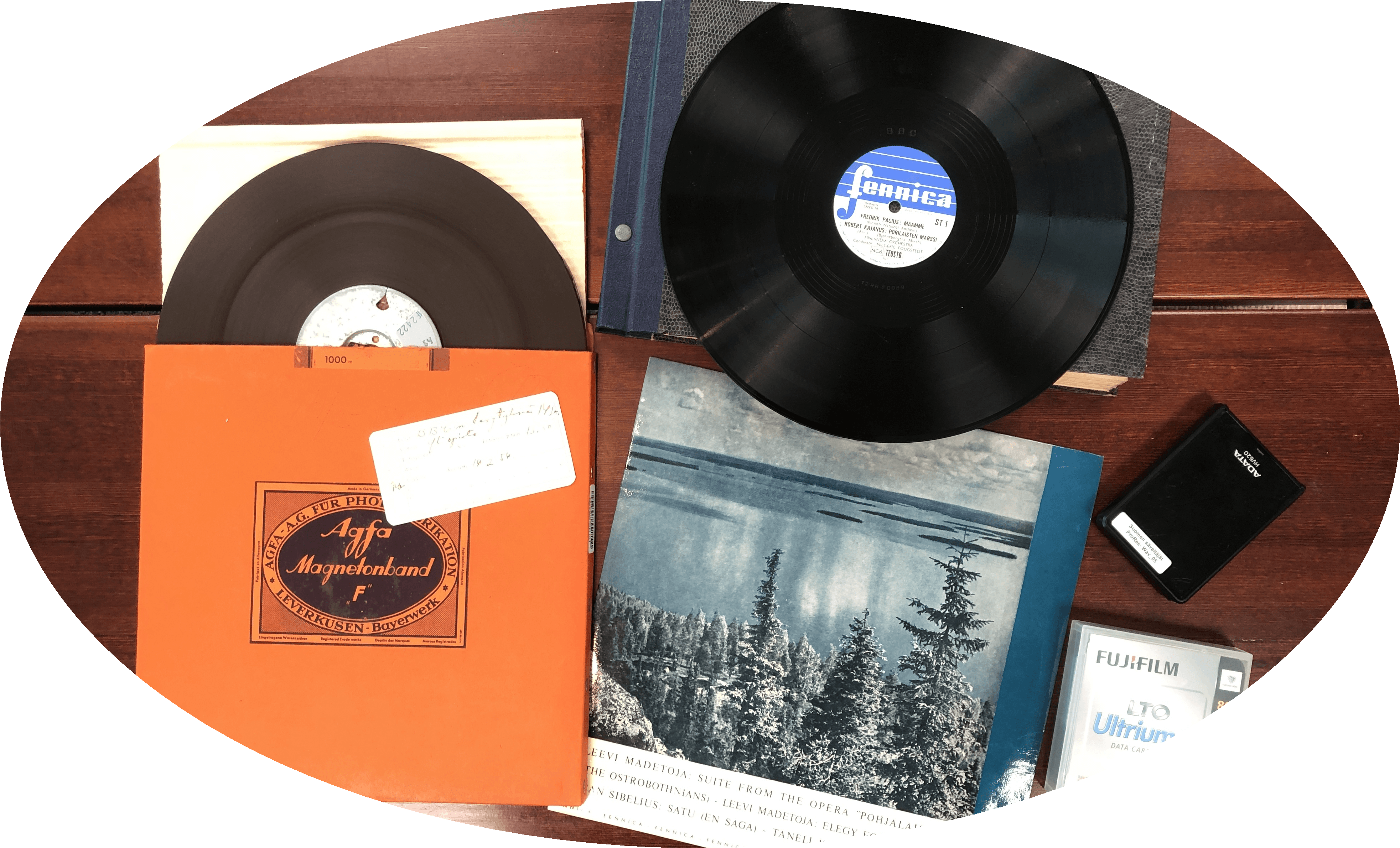
The Finnish music scene experienced modest years in the late 1940s. Take music records, for example: they were sold five times less than during the gramophone craze in the late 1920s. The few existing production companies focused on domestic entertainment and dance music. Due to general import restrictions, there was a shortage of foreign records.
Music records were out of reach yet also attractive. Composers of classical music realised this and urged that their music be presented not only in sheet music but also on records. The Society of Finnish Composers, an interest group founded in 1945, began to lobby for the issue. The Society's secretary, Kalervo Tuukkanen, approached members of parliament and newspapers and talked about how music records could be a tool for cultural export.
That message got through. In 1949, the Society applied for public support – and received more money than it had dared to ask for.

Soon, the Finnish Broadcasting Company Yleisradio also woke up. The company offered the project recording equipment, technical expertise and the services of the Radio Orchestra. In return, Yleisradio wanted recordings for programme use.
There certainly was a need for recorded radio music. Radio broadcasts were mainly live, and they were filled half with music and half with speech. Enjoying a monopoly position in the field of electronic media, Yleisradio emphasised classical music and related genres in its programmes.
The main problem was that it was no longer possible to fill the increasing radio hours with live music.
Yleisradio owned a collection of 7,000 records, but among them were only a handful of Finnish art music records. Such records were mostly foreign productions of Jean Sibelius's works. It seemed that the great goal of nurturing Finnish musical culture was failing at Yleisradio. The company's own recording activities were minimal.
Composers and radio joined forces. Soon Finland would enjoy previously unreleased recordings!
It was too good to be true. Nothing happened for a long time, and then when it did, it happened the hardest way. Operation Fennica lasted almost 18 years.
Yet the result was substantial. Fennica was a significant cultural heritage project. Covering the period from the 19th century to the mid-20th century, the record anthology contained 155 compositions by 44 composers. Leevi Madetoja, Aarre Merikanto and Jean Sibelius received the most attention. The number of female composers in Fennica was the same as the number of women in the Society of Finnish Composers, exactly one, Helvi Leiviskä.
The musical style focused on classical expression but extended to all sides. The emphasis was on shorter works. The larger works included Madetoja's Symphony No. 2 and Merikanto's Symphony No. 3. Of the main classical styles, only chamber music was missing.
.jpg)
A special studio orchestra was established for Fennica, the solemnly named Finlandia Symphony Orchestra. Conducted by Erik Cronvall, Nils-Erik Fougstedt, Jussi Jalas and Martti Similä, among others, it took care of most of the recordings of the first series.
A great project – but what made it so vulnerable and limping?
Technology is a problem
Uncertainty and failures characterised the project. It is telling that the name Fennica was not invented until 1954, and even then under duress, when the title was required for record labels. On the other hand, Fennica was the subject of great passions. The project ended in 1957, but a new sequel was launched immediately. It lasted until 1967.
There were financial problems, of course. The musicians' tariff negotiations slowed down the recording pace a couple of times.
However, money was the least of the problems.
The idea of Fennica was great but the technical readiness was low. First, Finland lacked professional recording studios. When Fennica finally started, the Finnish Composers booked the concert halls of the University of Helsinki and the Sibelius Academy for recording sessions.
It was anything but a perfect solution. The parquet floors creaked, a tram whizzed around a bend outside, and the tower bell nearby sent long straight beats. Some solo performers were terrified of the empty, echoing hall.
Second, Finnish know-how was modest. The Finnish Composers asked the British Broadcasting Corporation for recording help as well as for tape material. The BBC hesitated for a couple of years, among other things on the pretext that it had to get the Coronation of Elizabeth II out of the way first. Finally, a BBC recording engineer and a bunch of Agfa tapes arrived. The engineer did his best.

The recording sessions for the first phase of Fennica began in December 1953 and ended in March 1955. The recordings were printed by the British company Homophone, but the discs appeared to be scratched and stained, making them unsellable. Another painful year passed, now for making a complaint about the product.
The German company Deutsche Grammophon was chosen as a partner for the second part of the project. Once again, negotiations took abundant time, yet the sound quality and the disc printings appeared to be better. However, there was a delay in the final stages when someone noticed that the record labels had been printed incorrectly.
Time was not on Fennica's side. The recording industry was going through a technological transition. The new LP record replaced the 78 rpm record and, gradually, stereo sound superseded mono sound.
Fennica trusted the old.The first part of the anthology was mainly released as 78 rpm records. The maximum duration of one side of the disc was four and a half minutes, which meant that the records could not accommodate longer works. None of the Fennica records were released in stereo format.
The anthology's layout did not make things any easier. The album covers repeated the same bleak black-and-white image of the Finnish natural landscape. The cover texts were sparse.
People are the problem
When word spread that the recording project was being created, speculation began about who would be allowed to join the process. Conductor Ilmari Hannikainen was at the top of the VIP list, but his requirements were too demanding. An agreement was not reached until 1959.
Even greater controversy revolved around composers and their works. Who wouldn't have wanted to be part of a project that was to be the glorious flagship of Finnish music exports?
The expectations surrounding the project could be high. When composer Heino Kaski came to observe the recording and mixing of his Prelude, he was dressed solemnly in a tailcoat suit. Noticing the mundane nature of the situation, Kaski felt embarrassed, buttoned his outerwear up to the collar and wrapped his scarf tighter, even though it was scorching hot in the ballroom hall.
People were only one part of the problem. The way the project was administered was another.
There was no producer mentality in Finland, least of all in art music recordings. The project was supervised by the board of Finnish Composers. The members knew all about the music content but hardly anything about recording practices.
The Society's secretary Kalervo Tuukkanen and his successor, Martti Turunen (known also as the director of the Finnish copyright organisation Teosto), carried out the administrative matters. At Yleisradio, the project was coordinated by Lauri Saikkola. All three were composers and had a chance to include their works in the anthology.
Bureaucracy was a problem. The early 1950s were still a time of strict economic regulation, and, for example, purchasing Agfa audio tapes from Britain was behind many customs papers. Furthermore, the tax administration reversed its original decision and slapped arrears of one million Finnish marks on the Society (ca. 30,000 euros today).
In the end, the artistic side seemed to work best. The music performances mostly went well.

And the winner is...
Despite all these difficulties, Fennica had consequences that reached far beyond the records themselves.
A strange feature of Fennica is related to the relationship between the two main actors. The Society of Finnish Composers was the key driver. Yleisradio assisted – and received the broadcast rights to the recordings in return. It was a brilliant move. Although the sales of records brought decent income to the Society, the biggest winner was Yleisradio.
The 1953 annual report of Yleisradio mentioned that the company had launched a new recording project that would focus on previously unreleased music. Such taping activities later became known as "kantanauhat", Yle original music tapes with permanent transmission rights. The first tape was Porilaisten marssi (March of the Pori Regiment, origin unknown). It was also the first Fennica recording. Accordingly, other Fennica recordings ended up as Yle original music tapes.
The Fennica project offered Yleisradio the chance to enlarge the Radio Orchestra into the Radio Symphony Orchestra as well as to learn recording practices. Within six years, the company was already producing more studio-quality recordings than all the record companies in Finland combined. In addition to classical music, the company recorded folk music, entertainment music, children's music, sacred tunes and jazz, and later also "iskelmä" (Finnish schlager), pop and rock.
Oddly enough, Yleisradio documents neglect the contribution of the Society of Finnish Composers, even though it was the Society that paid the dues for the success story. It is also odd that later accounts of Finnish Composers do not mention the tape project at Yleisradio.
.jpg)
Echoes of Fennica
What kind of legacy did Fennica leave for Finnish composers?
From the mid-1950s to the late 1960s, the Society of Finnish Composers was the largest classical music record producer in Finland. After Fennica, it continued to produce music, but no longer at the same volume.
Fennica was a great test. It proved that the Society was capable of executing difficult projects. The current reputation of the Society as an active interest organisation for composers was created during the Fennica years.
But Fennica left another legacy as well: the recordings themselves.
Apart from some single endeavours, Fennica recordings have not been republished since the 1960s. Certainly, many parts of the anthology are outdated: there are new versions with better sound quality available for music listeners.
Some Fennica echoes still persist, though. In the 2010s, the Society of Finnish Composers had the original tapes digitised. Later on, the Society handed over the Fennica recordings and archive materials to the National Library of Finland for researchers to use.
At that point, Yleisradio had already digitised its own Fennica master tapes and made some of them freely available to the public, for example Karhunpyynti (Bear Hunt) by Kalervo Tuukkanen.
Thus, recordings that had been so difficult to create in the first place have survived long after the original Fennica records themselves disappeared from circulation.

Sources
Annual Reports 1953–1967. Yleisradio.
Fennica. Project archive. National Library of Finland & Society of Finnish Composers.
Einari Marvia. 1970. Suomen Säveltäjien 25 vuotta. Helsinki: Suomen Säveltäjät.
Janne Mäkelä & Maiju Kannisto. 2025. Arkistokuumetta mediayhtiössä. In Kulttuurin vuosisata. Luova ohjelmatyö Yleisradiossa 1926–2025. Eds. Anu Koivunen et al. Helsinki: SKS, 464–487.
Erkki Salmenhaara. 1995. Säveltäjänä Suomessa. Suomen Säveltäjät 50 vuotta. Helsinki: Otava.