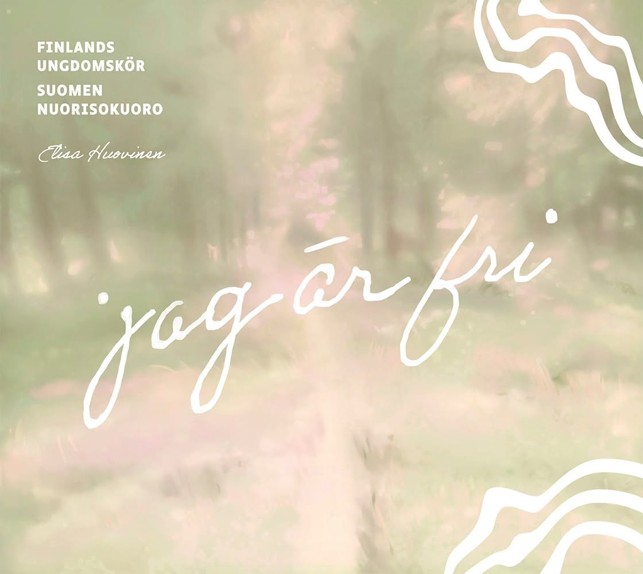
At the beginning of June, the Choir Recording of the Year 2025 was announced. The selection was made jointly by the Finnish Amateur Musicians’ Association (Sulasol), the Finnish Choral Directors’ Association, and the Finnish Broadcasting Company (Yle). The award went to Jag är fri, the second full-length album by the Finnish Youth Choir. The recognition continues an impressive trajectory: the choir’s debut album, Triumf att finnas till (“The Triumph of Existing”), was also named Choir Recording of the Year in its year of release. On the basis of these two recordings, it increasingly appears that this is not simply a matter of isolated success, but rather the result of a remarkably consistent artistic vision, cultivated by artistic director Elisa Huovinen through imaginative commissioning and carefully curated programming.
The driving force behind the album is a set of commissioned works written for the choir’s fifth-anniversary concert. What makes them particularly interesting is that they are not merely pieces written for the choir, but works in whose creation the singers themselves played an active role. During a workshop held in 2023, choir members explored themes of identity, community, emotions and the relationship between humans and nature through poems, prose texts, reflections and drawings. The material generated in the workshop was then given to the composers to use freely as a starting point for their creative work. The method was not new to the choir: two commissioned works by Säde Bartling on the choir’s debut album also originated from texts written by choir members.
The album’s four commissioned works form a stylistically diverse collection, yet they are united by recurring questions of identity, belonging and the search for one’s own voice. Tytti Arola’s “Heijastuma” (Reflection) was inspired by the word “echo,” which repeatedly appeared in the choristers’ writings. According to the composer, an echo exists in an in-between space: it requires both a sound and a surface from which it can be reflected. Arola develops this into an analogy for the formation of community. Musically, the piece does not return to its starting point but unfolds as a journey through changing landscapes. What begins as calm and almost meditative gradually expands into large textural fields before culminating in a rhythmic celebration that nevertheless retains a sense of lightness.
Ossi Hiltunen’s “Ääriviivat” (Contours) approaches questions of identity from a different angle. According to the composer, the work centres on growing up and on society’s expectations: what does it feel like to grow within a community that seeks to fit people into predefined moulds and what is it like to have to justify one’s own existence? The strength of the piece lies in its restraint. Hiltunen avoids grand climaxes and makes no attempt at overt display. The music seems to examine, in keeping with its title, its own outlines, their shifting and transformation. The result is both delicate and compelling.
The direct transition from “Ääriviivat” to Ida Olsonen’s “fosterland” (fatherland) is one of the album’s most effective dramaturgical moments. Whereas Hiltunen’s work contemplates identity from within, Olsonen’s composition gives voice to open rebellion. Larry Silván’s poem begins with the declaration: “I am not a citizen of Finland”. The speaker refuses to belong to a community that does not feel like home. Olsonen’s music responds to the text with urgency and fearlessness, drawing on expressive devices both within and beyond the classical tradition. Moods shift rapidly, rhythms fracture, and the harmonic world changes in an instant. The composer’s own description of the piece as a “musical kaleidoscope” feels entirely apt. Placing Hiltunen’s and Olsonen’s works side by side also reveals the breadth of the Finnish Youth Choir’s expressive range, from subtle introspection to full emotional release.
The sequence of commissioned works concludes with Andrea Eklund’s “Jag är fri,” the piece that lends its name to the album. Here, the themes explored throughout the workshop seem to arrive at a kind of resolution. “Jag är fri” moves toward acceptance and freedom. Of the commissioned works, its musical language is the most traditional, although the occasional juxtaposition of diatonic sonorities may bring Einojuhani Rautavaara to mind. Long melodic lines and a naturally breathing form create a spacious musical landscape. The music serves Hanna-Madeleine Andersson’s text, written specifically for the piece, in which darkness gives way to light and heaviness to ease.
Although Jag är fri is built around its four commissioned works, the album’s success also depends on the broader programme surrounding them. One particularly effective pairing places Eklund’s “Jag är fri” alongside Ēriks Ešenvalds’s “The Sea Wind.” Both works express a longing to move beyond the confines of the mind toward a more open and expansive space. Alongside these pieces are works by Ester Mägi, Anna Gallon, Erkki Salmenhaara, Virpi Eroma and Ilkka Kuusisto, each addressing related themes in their own way while also serving as musical bridges within the album’s carefully constructed whole.