“In my temptation to stop time, I have the irrational feeling that, if I succeed, time will become space and I will be able to enter a secret realm where I have never been before.”
– Kaija Saariaho*
Kaija Saariaho considered it the composer’s mission to reclaim control over time, in music as in real life. Time, she believed, is a precious resource of which we are collectively robbed, and music creates a space where it can be experienced freely, without accountability, a space to breathe deeper and more intensely.
The new anthology of Saariaho recordings conceived and helmed by Anu Komsi and Sakari Oramo (Ondine, 2026) presents a meaningful sample of the composer’s work on time from both ends of her career. In bringing them together, the album also contextualises Saariaho’s quest within her biography, and is a poignant testimony to her own struggle to find and control the time she so craved and came to lack.
SAARIKOSKI SONGS (2013–2020, orch. 2020–2021)
Anu Komsi was a close collaborator of Saariaho’s starting from the late 1980s, championing her vocal music in countless settings and, in the 2000s, commissioning from her a series of songs after the late Romantic poet Eino Leino (1878–1926). In 2013, in response to Komsi’s follow-up invitation to create a short song on a text by a modern Finnish poet, Saariaho set a poem by Pentti Saarikoski (1937–1983), the erudite lyricist and dazzling political provocateur. The collection chosen by Saariaho, Alue (The District, 1973), displays Saarikoski’s melancholy side, as he contemplates the destruction of the forest in his neighborhood of Pohjois-Haaga in Helsinki to give way to new apartment buildings. The contrast to her usual choices of texts attracted Saariaho, and Luonnon kasvot (The Face of Nature) was premiered a few months later by Komsi and pianist Pia Värri.
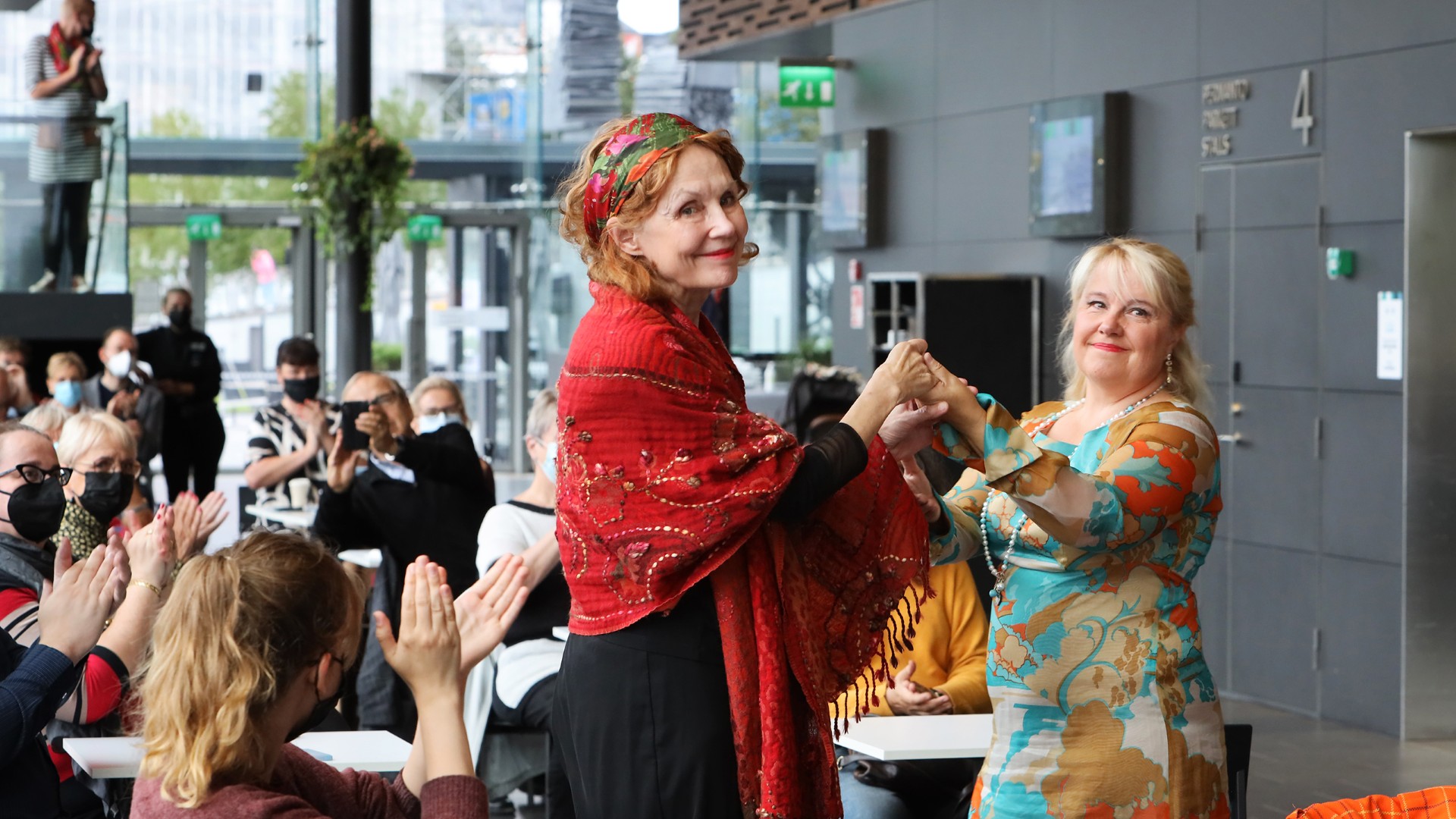
As with the earlier Leino Songs, composed over seven years and eventually arranged for orchestra, there was enthusiasm to expand Luonnon kasvot into a full cycle based on Saarikoski poems, but Saariaho couldn’t take on a larger commission, being already committed to many projects, including two operas. Instead, she chose to revisit the world of Alue regularly on ‘stolen time’ between larger ventures, as was her habit with smaller projects that mattered to her. She set two additional poems in 2017, between the first three acts of the opera Innocence, and two more in 2020, during the first Covid lockdown. In the last instance, Kaija and myself were in the midst of creating the ‘science-fiction madrigal’ Reconnaissance of which I was the librettist, and she asked me to help create the montage that would allow her to shape the Saarikoski cycle into more than a collection of individual songs. She came to regard both works, the Saarikoski Songs and Reconnaissance, as her two manifestos on man’s fraught relationship to nature, a theme that pervades her entire output, but which she had never dealt with as confrontationally.
As the text itself didn’t call for the sensual ornamentation characteristic of her vocal music, Saariaho built expressive vocalisations around the almost bare prosody of her setting, in a way quite similar to how she was herself composing around weeks reserved for other projects in her calendar. These lyrical melismas bear striking similarities with the very next music she composed in the summer of 2013, and can be considered a sketch for it: the beginning of her opera Only the Sound Remains, in which the lamenting spirit of a fallen warrior is released from the torment of the afterlife by a religious service. In Luonnon kasvot, it is the voices of extinct birds that call out to us, eventually silenced by the electric saws that, in the orchestrated version, are heard in the low strings of the final bars. In the following songs, this duality is further developed in the opposition between the mechanical ostinatos of construction work and delicate textures shining through. The orchestrated version showcases nature as Saariaho saw it: an iridescent panarchy that may not look or sound as strong as bulldozers, but prevails through resistance, adaptation and diversification, and its slow expansion into time-frames that ultimately dwarf our human condition.
Orchestrating the Saarikoski Songs for Anu Komsi and Sakari Oramo in the fall and winter of 2020 was the culmination of a passion project by a composer who fought to find time to listen to the music within and around her. She was intent on taking her first sabbatical in decades after completing them. However, just days after signing the final double bar in January 2021, Saariaho was diagnosed with the brain cancer that came to claim her life. She had just finished orchestrating the final song:
The interstitial time
petrifies
into mountains that I see
without looking through the mist.
In her ensuing twenty-eight months of illness, Saariaho struggled to work, and only completed one final work, a musical farewell: the trumpet concerto HUSH.
VISTA (2019)
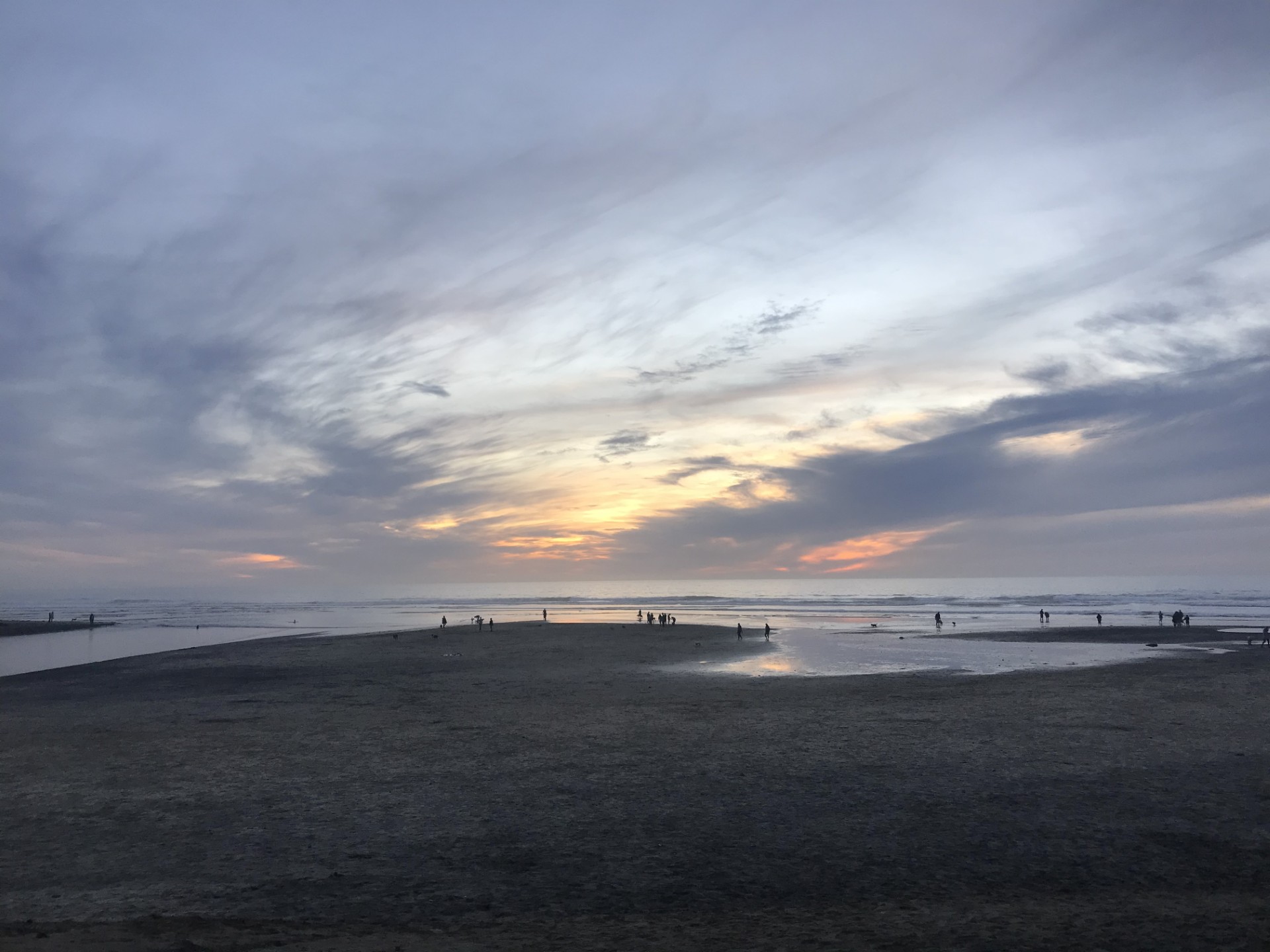
Kaija Saariaho had been composing the opera Innocence for two and half years of a strict daily work schedule, when she put the finishing touch to its score in December 2018. She knew her next work would be a commission for Susanna Mälkki’s Helsinki Philharmonic Orchestra, and was excited to write for orchestra more freely, without thinking of text and having to tip-toe around singing voices, which are so easily covered by instrumental masses. A few weeks later, after attending the U.S. premiere of her harp concerto in Los Angeles, she drove down the scenic Interstate 5 highway to San Diego with her husband, and encountered an image that matched her exact feeling in that moment: signs indicating ‘Vista Points,’ exits to locations from where to enjoy a peaceful view on the coastline and the ocean. No more smuggling of smaller projects in the interstices of operas – just a free, open horizon. She devoted the following months to the calm creation of a work that would capture the hopeful opening of new, unexpected landscapes.
For these landscapes to actually feel fresh and new, Saariaho gave herself the difficult challenge of dispensing with the instruments – harp, piano and celeste – and sustained string textures that usually helped her clarify and bind together harmonies in an orchestral context. Her orchestration then had to be organised differently: the woodwind and brass sections were invited to take the lead melodically, harmonically and rhythmically, and Vista bathes entirely in their warm, breathy colours.
The work’s first movement, "Horizons," can be seen as an exploration of these new hues, characteristically placed into a continuum where individual instrument groups dominate only in passing, always transitioning through shared registers and colors magnified by pervading touches of percussion and strings. In the opening bars, two oboes, one the bass to the other’s melody, draw the titular horizon line, both steady and seemingly shimmering with heat, gradually growing into a full landscape as other instruments join in, and a journey is started: fifteen minutes of uninterrupted sonic travel. As with the restless orchestral machinery of Innocence, we seem to be transported from one location/atmosphere to the next without so much as slowing down, even when the scenery itself exudes peace. Constant shifts in rhythm and instrumentation and insistent patterns of wide intervals keep the tension at a permanent high.
This intervallic teasing is radicalised in the crazed ostinatos of the shorter second movement, "Targets," in which instrumental groups are more dramatically set against each other and clashing in entangled clusters. We are suddenly drowning in contradictory information, as if trying to use a map and to read road signs instead of simply enjoying the view as previously. Just as well we can imagine being with the composer at her work table, as she contemplates multiple new musical avenues, uncertain which to follow, and ultimately maximising her use of all parameters in a way unheard in her music since her roaring thirties. Refusing to choose, she coaxes all the strands of her musical thinking into an incredibly rich double climax, which she then unwinds in five minutes of gradually thinning music, in which an ocean of new possibilities seems to open.
The premiere history of Vista stands in ironic contrast to the work’s aspiration to open skies: the premiere, planned in March 2020, was cancelled due to the outbreak of Covid and, after several postponements, took place in May 2021, still only in the form of an online stream and with a smaller orchestra to accommodate safety distances on stage. Over months and months of uncertainty, the broad landscapes struggled to open, and the inability to hear whether her new solutions worked paralysed Saariaho to the point of refusing new commissions. In retrospect Vista swarms with bittersweet visions of paths the composer never had the opportunity to explore.
KOLME PRELUDIA (1981)
The organ being the instrument Kaija Saariaho played in her twenties, there is reason to be surprised she composed only a handful of pieces that make use of it. Just as surprising is how little attention has been given to the organ’s influence on her musical thinking, from her interest in subtracting harmonies from clusters to her taste for digital analysis and reconstruction of individual instrumental timbres and their implementation in a playable context, a prospect in which the organ is the direct ancestor of the synthesiser.
The summer of 1981 found Saariaho at a crossroads, leaving Helsinki to continue her studies in Freiburg, while also contemplating a training in computer music in Paris. She had been trying to remix the music of her recently premiered first stage work, Study for Life for soprano, tape and composed lighting, into a radio piece, without being too convinced by the result. She didn’t have a commission and didn’t know where to go next. This is when she undertook the composition of ‘three preludes’ for soprano and organ.
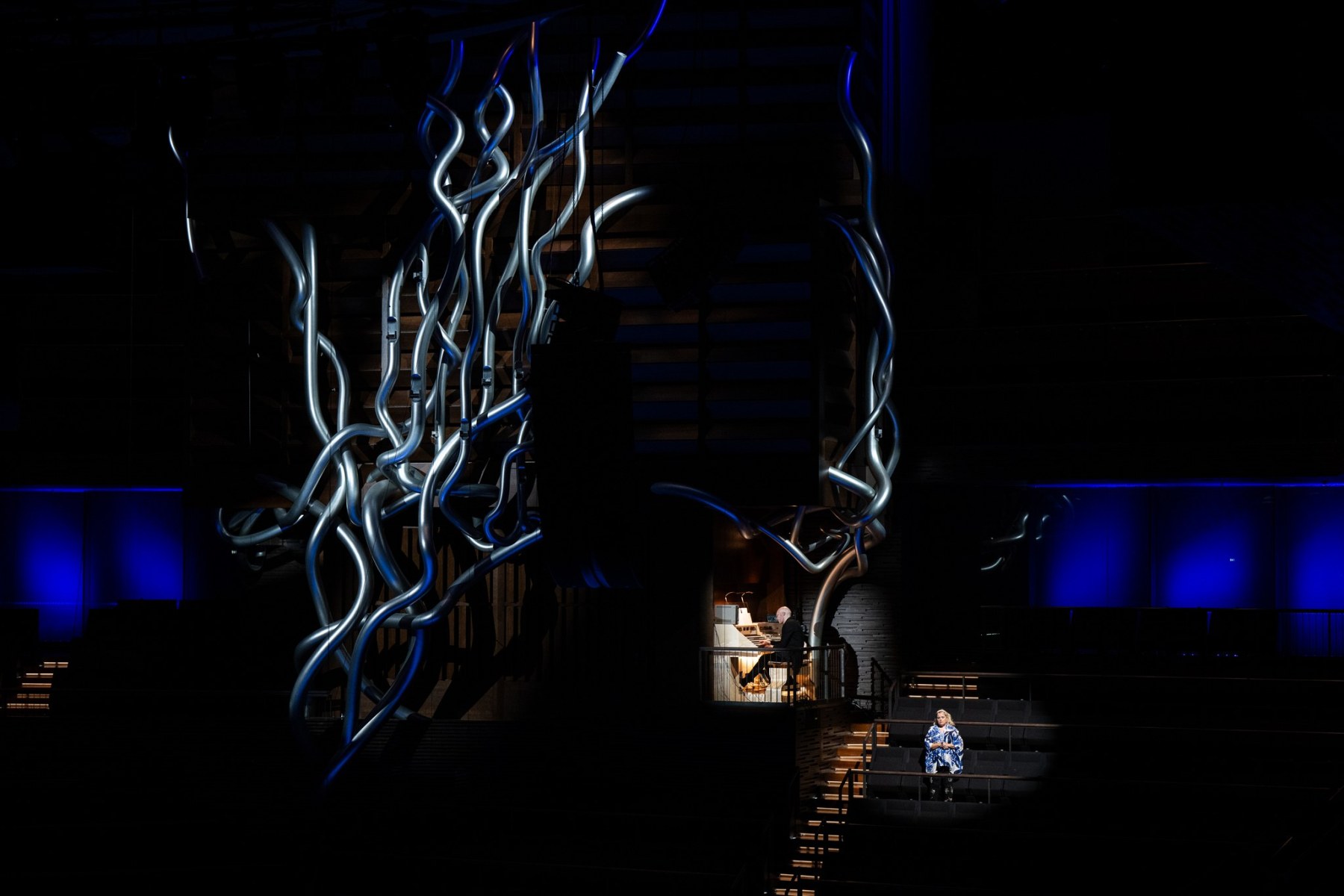
Her only setting of Biblical material, these three miniatures – that run less than three minutes each – are expressionistic fragments rather than devotional hymns, but can be taken to concentrate and universalise the emotions expressed by the psalmist: existential dread, frustration with earthly affairs, craving for consolation. Although Saariaho brings range and variety into the organ texture, and expertly mixes registrations in ways that foreshadow her use of electronics in later works, the mighty machine never overpowers the soprano’s quasi-plainsong, but rather supports and expands it like an accompanying guardian musician angel. This dream of vocal-instrument symbiosis she would revisit only years later, with the help of computer technology and sophisticated sound analysis and treatment.
Kolme preludia was composed spontaneously, without a commission, and only came to be premiered in the following year by Aulikki and Pertti Eerola. Why did Saariaho engage in such a project out of the blue? In her diary, she candidly asked herself that same question, and her answer resonates deeply with the quest to which she remained devoted for the following forty years: “I have been working on three small organ+soprano thingies on the pretext of participating in some competition. What the real reason is, I don’t know. I guess I simply wanted to COMPOSE.”
* Quotation from Kaija Saariaho’s interview with Clément Mao-Takacs, published in Kaija Saariaho: l’ombre du songe. Tempus Perfectum, no. 11. Lyon: Symétrie, 2013.
Aleksi Barrière is a French-Finnish writer-director who explores the many shades of interdisciplinary and intercultural collaboration through the means of contemporary music theatre, leading the Paris-based collective La Chambre aux échos and the Finnish arts organisation Kimaira. He works as a dramaturge and librettist with multiple composers, including Kaija Saariaho on her final works.