.jpg)
Tampere Biennale prelude at Kaapelitehdas, 11 April 2026
That Saturday night, in the copper glow of Avanti’s hall tucked inside the brick labyrinth of Kaapelitehdas, the air was charged with that rarest anticipation: the moment just before a festival begins. Composer and Tampere Biennale director Minna Leinonen, curating and MC’ing the evening, welcomed the audience with a blend of poise and quiet humour, as if inviting old friends into a working rehearsal that happened to contain a handful of finely honed works.
The programme unfolded as a constellation of strong female voices and their allies across centuries: from the medieval Comtessa de Dia’s troubadour song A chantar m’er to Kaija Saariaho’s timeless Lonh, with Agata Zubel’s Unisono III sparkling between them. On the way, there were stops with Lotta Wennäkoski, Enno Poppe and Leinonen herself.
Lotta Wennäkoski's Sic opened with twin violins, Anna-Leena Haikola and Terhi Paldanius, dartingand teasing like bright birds in close formation. Enno Poppe’s Wespe (“Wasp”)for voice and dancer followed as a compact study in nervous energy: buzzing figures,sudden feints and microscopic stings deftly articulated by Meeri Pulakka, soprano and Sofia Keto-Tokoi, dancer.
.jpg)
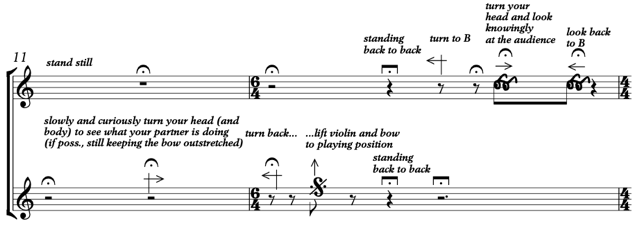
Leinonen’s own …and we are rotating with, winner of the Teosto Prize, anchored the first half with a different kind of motion. Here the Avanti quartet’s fragile tremors, slow glissandi and ghostly whirling harmonics suggested planetary drift rather than virtuoso display – the almost imperceptible turning of bodies in space. Introduced with characteristic understatement, the work made cosmic rotation feel intimately human. The Avanti Quartet consists of Haikola and Paldanius (violins), Pisku Ristiluoma (viola) and Mikko Ivars (cello).
If there seemed, as the evening progressed, to be an unusually strong emphasis on gesture, on visible action by the performers as well as sound, this was no accident. In correspondence afterwards, Leinonen traced her thinking back through the 40-year history of the Tampere Biennale and its founder, Usko Meriläinen. His mission was to highlight new Finnish music, including works that might otherwise remain unperformed, and to insist on second performances – one reason Leinonen’s own quartet found its way onto this programme. Equally important were Meriläinen’s values of reaching new audiences and fostering interdisciplinary collaboration, themes Leinonen has consciously continued as a tribute to his legacy.
Meriläinen’s wife, Ruut Matso, was a dance artist, and that connection to movement also informs the current festival. Leinonen brought together soprano Meeri Pulakka and dancer Sofia Keto-Tokoi to create Kietoutumia (“Entanglements”) a joint project for Tampere Biennale whose preview formed part of this Avanti! Klub evening. She describes her curatorial choices as rooted in the Biennale’s past but not restricted by it: “What I decided to bring from those forty years didn’t limit my thinking, it expanded it.” For her, artistic collaboration across disciplines is a way of connecting with others in ways impossible by other means – a route to less conflict and more understanding for artists, audiences and the wider arts sector.
.jpg)
After the interval – porcelain clinking in the foyer, electronics quietly blinking on stage – Agata Zubel’s Unisono III set the air gently on edge. Soprano, cello and live electronics were gleefully animated by Pulakka, Ivars and Anders Pohjola with their gestures and deadpan delivery. The piece became a kinetic field once Pulakka’s voice fractured, whispered, declaimed and soared; Pohjola’s movements and the live processing seemed to pass the same energy between body and loudspeaker, breath and string
Not all of the dramaturgy was intentional. From the adjacent hall, a loud drum-and-bass event – booked independently, beyond the presenters’ control – sent low-frequency shockwaves through the cement structure. The interference remained mostly at the thresholdof hearing, but it was unmistakable. At times it evoked, by a queasy historical association, the anecdote of Madame Wanda Landowska’s harpsichord recital in Paris as German bombs fell in the distance: carefully shaped phrases set against an indifferent, insistent rumble. In Kaapelitehdas, the threat was financial and systemic rather than military – a reminder of the “attack on the world’s pocketbooks”, the economic turbulence and structural precarity surrounding in our present moment. The audience, performers and technicians did what musicians have often done: acknowledged the disturbance inwardly and listened more intently.
From that tension, the closing works drew a surprising calm. Comtessa de Dia’s A chantar m’er, in Pulakka’s clear, focused delivery, formed a slender bridge to Saariaho’s Lonh, a work whose exploration of distance and desire now carries the added weight of the composer’s absence. Sung with luminous restraint, Lonh seemed to place the evening’s many layers – medieval and contemporary, acoustic and electronic, choreographic with Keto-Tokoi soliloquy and purely sonic, intimate chamber textures and concrete-shaking bass – on a single axis of listening.
When Leinonen returned to the stage to thank the audience, she was met by applause that rose before she could speak. Avanti! is returning to Tampere Biennale after a gap of some twenty years; the sense of a circle closing was hard to miss. In the end, what emerged from this compact pre-Biennale portrait was not a manifesto but a set of lived practices: roots acknowledged, disciplines intertwined, and new audiences invited in, even through the noisy realities of contemporary urban life.
Corno di Bassettino left Kaapelitehdas with ears still vibrating, struck by how stubbornly beauty insists on being heard – even when the walls themselves seem to rumble.
Corno di Bassettino is the nom de plume of an observant chronicler of musical life, active across concert halls, festivals and experimental spaces in Finland and abroad. Their reports trace the intersections of new music, history and the sounds of the surrounding world.
Featured photo of Minna Leinonen by Robin Lindeberg.