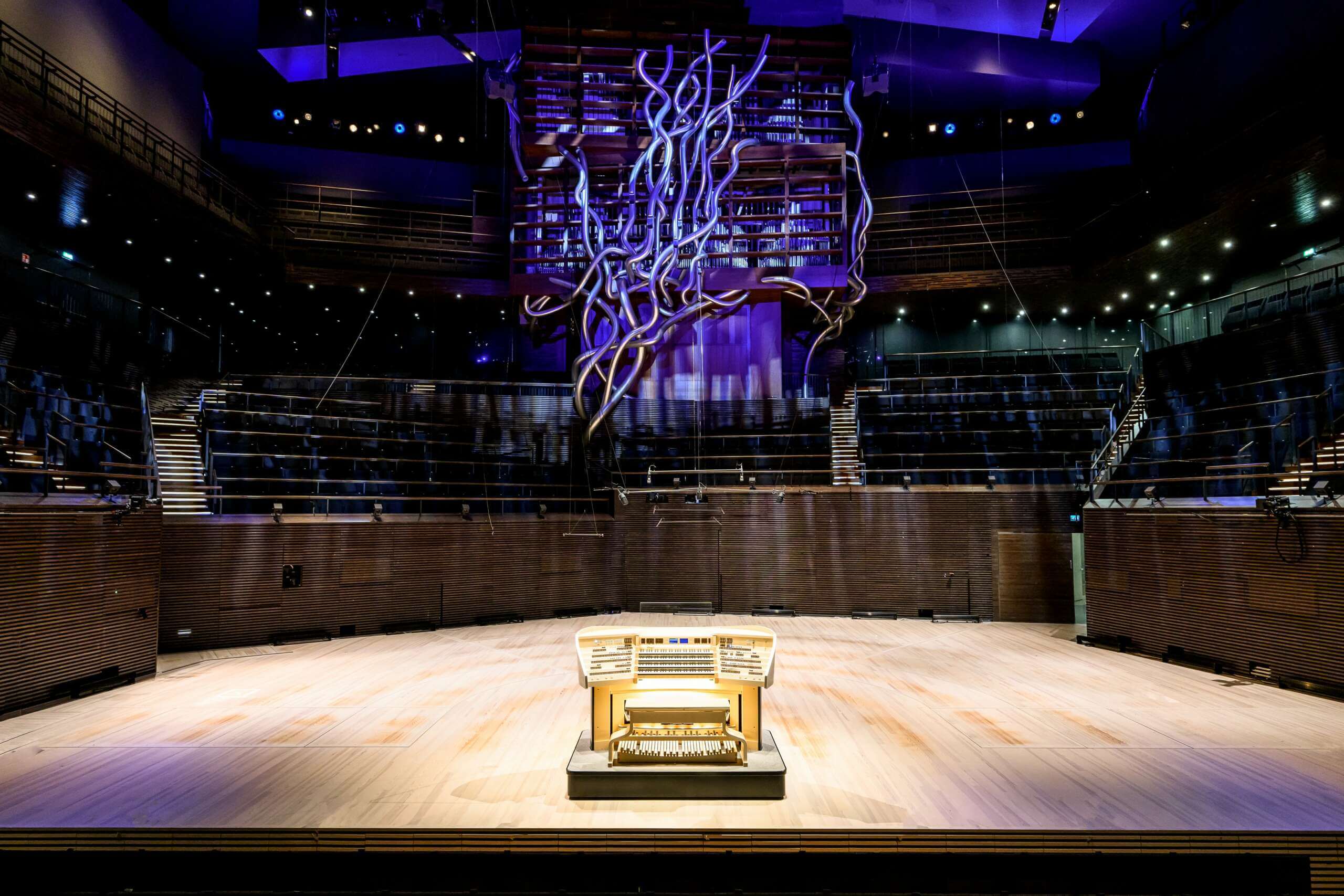
Intricate, glittering tubes like coiling roots capture the attention of a new visitor and greet the regular concertgoer like a familiar face. The organ façade, now dominating the Musiikkitalo main hall, has already become a new symbol for the concert centre in the two years since the long-awaited instrument was inaugurated. It is easy to forget that for years the audience stared at an empty surface, waiting for the concert organ since the building’s inauguration in 2011.
With all the difficulties marking the organ’s journey into existence, the team responsible was apprehensive about potential problems with its use and prepared intensively for them. For here’s the thing: it was not enough to build an organ that would sound great in a concert hall – easier said than done. The next challenge was to make sure it would actually be played.
The Musiikkitalo Organ Association, responsible for the instrument’s maintenance, ensures, first of all, that the organ remains in active use. At a very early stage, its priority was to dismantle barriers that would keep the organ silent. “It’s an unfortunately common fate for a concert organ,” says Jan Lehtola. He is one of Finland’s leading concert organists, a lecturer at the Sibelius Academy, and the chairman and artistic director of the Musiikkitalo Organ Association since its foundation in 2019.
“The organ has exceeded all our expectations. We were very anxious that things would turn out similarly to the Sibelius Hall organ in Lahti, which is hardly ever played and needs a complete renovation. Now it seems we were even too stressed out,” Jan Lehtola smiles. “This is a success we didn’t dare to dream of.”
The organ has been used in a variety of settings: solo recitals, concertos and orchestral works, choral concerts and family events. The performers have included young talents, world-class organists from Olivier Latry and Zuzana Ferjencikova to Stephen Tharp, and artists from non-classical genres now eager to incorporate the organ into their shows. There were 600 hours of nighttime use in 2024 – with the hall in constant use during the day, much of the concert preparations has to take place at night.
.jpg)
Premiere after premiere
Though designed as a hybrid organ suited to all styles, a special emphasis was placed on the requirements of contemporary music, such as the use of microtonality. These features have been put to use right from the start, since the organ has given rise to a vast number of premieres.
A total of 13 new works, from solo compositions to organ concertos, resulted from an international composition competition, organised in 2023 by the Organ Association and named after Kaija Saariaho. Musiikkitalo’s resident orchestras followed suit, commissioning and programming works featuring the organ. The instrument, in turn, has kindled the curiosity of established composers. Future highlights include Sebastian Fagerlund’s organ concerto Ad Spiram, which will be premiered by Iveta Apkalna and the Helsinki Philharmonic Orchestra in November.
Organists such as Susanne Kujala and Jan Lehtola have been busy bringing new works to life. In his Musica nova Helsinki recital in February 2025, Lehtola premiered a total of nine works. One of the commissioned composers was Mioko Yokoyama. Winner of the prestigious Teosto Prize in 2025, she has been living and working in Finland since 2015. Her Teosto-awarded composition Mineralization was recently featured on a profile album by Uusinta Ensemble.
Before writing her organ piece Wind Talks for Lehtola, Yokoyama was already pondering composing for the organ. She was impressed by the quantity of contemporary organ music composed in Finland, naming Kaija Saariaho’s concerto Maan varjot and the duo Offrande as particularly inspiring. Saariaho, who played the organ in her youth and served as the angel investor behind the Musiikkitalo organ, indeed emerges as the matriarch of contemporary Finnish organ music.
After hearing Matthew Whittall’s organ symphony Joy, commissioned and premiered by the Finnish Radio Symphony Orchestra and Susanne Kujala in May 2024, Yokoyama was eager to get to know the new organ.
She recalls Lehtola taking her and three other composers to hear the new organ – in the middle of the night, naturally – and introducing them to the possibilities of the instrument.
“And we all had different favourites among the organ’s special features and wrote very different pieces,” says Yokoyama delightedly. A video recording of the nocturnal session turned out to be an invaluable source of material for the piece.
.jpg)
The organ is a wind instrument
What especially enchanted Yokoyama was the adjustability of individual stops.
“When a stop is set halfway, it produces an obscure, airy sound that I loved.”
Wind Talks also makes heavy use of the so-called Flexible Wind System, an air-pressure control mechanism that enables the player to increase and decrease the amount of air inside individual pipes with a pedal, producing sounds that move in and out of tune.
“It makes a breathy sound, like a wind instrument that is played with less air,” Yokoyama explains. “It can also create a quiet pulsing effect when the air pressure is low enough.”
As the title Wind Talks suggests, Yokoyama concentrated on the air-like qualities inherent in the organ. She didn’t want to approach the organ in a similar way to the piano, her primary instrument, or any keyboard instrument, for that matter.
“The first thing I wanted to focus on was finding the difference between the piano and the organ. They may seem similar, but that similarity lies only in the fact that fingers are moving on a keyboard,” she smiles. “I felt that the organ is actually a wind instrument.”
The organ is often compared to a symphony orchestra as well. Though at home with orchestral writing, Yokoyama didn’t want to take that approach either. Written with chamber-like transparency, she likens Wind Talks to a flute trio. The use of graphic notation adds to the wind-like, breathing character of the work.
As it happens, Yokoyama’s next organ piece is already finished, a chamber work for cellist Anssi Karttunen and organist Olivier Latry, the same duo responsible for the premiere of Saariaho’s Offrande (2014). Vortex Generation will be premiered in Paris in November this year.
When working on Vortex Generation, Yokoyama was reading a Japanese novel in which an organ builder was one of the characters.
“This character says that there are two kinds of composers: those who get to compose for the organ and those who don’t, and I’m very lucky to count myself in the first group,” Yokoyama says.
New perspectives
Jan Lehtola has given more than 195 world and regional premieres. His recent premieres include concertos by Maija Hynninen and Federico Perotti, the latter being one of the prize winners in the Saariaho Composition Competition.
“It was amazing how well Perotti had managed to use all the special features of the instrument without seeing it once,” says Lehtola. “He made the organ a hybrid between strings, percussion and winds, a whole new instrument in its own right.” (Listen to the concerto here.)
In Hynninen’s Helios, commissioned by Lehtola and premiered at the Helsinki Festival, an unreal cosmic world unfolded by means of microtonality.
“It was generally thought that the organ as an instrument had reached the end of its development, but, unbelievably, here we have an organ that offers completely new ways of playing, composing and even listening.”
Indeed, with its original design and impressive sound, the Musiikkitalo organ has become an attraction in its own right. The guided organ tours, held regularly, are mostly sold out, and the organ concerts are attracting unprecedented audiences. A new organ culture, independent of religious spaces, has formed in Helsinki, Lehtola muses.
“In my Musica nova recital, there were 800 listeners. It is totally unheard of for contemporary organ music to draw such audiences,” he exclaims.
Featured photo Sakari Röyskö.
