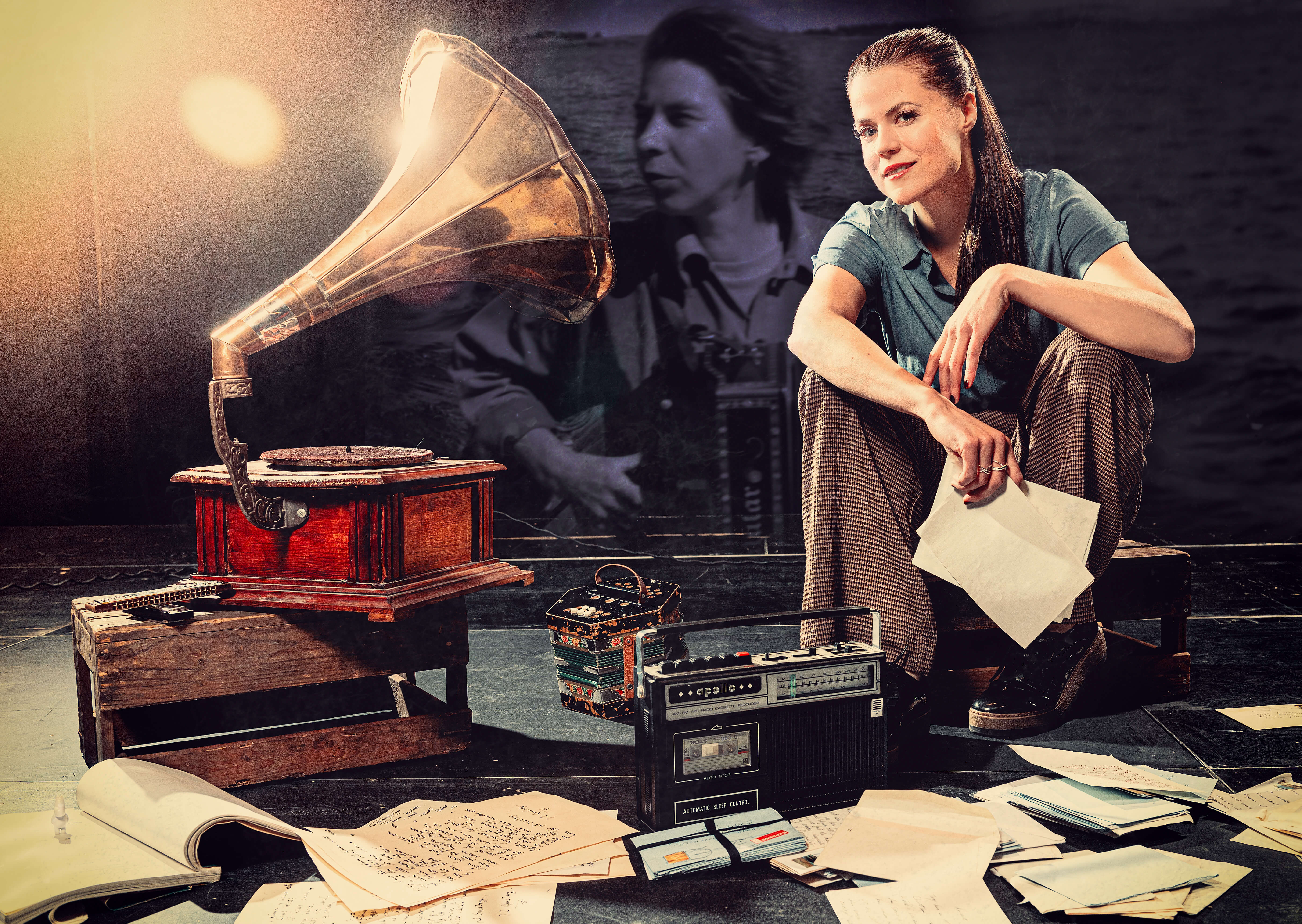
Tove Jansson was a visual artist and author, creator of the Moomins. She also penned lyrics to songs some of which remain well known, such as the classic Höstvisa [Autumn song] by Erna Tauro. However, the extent of her lyric writing and the depth of her musical sensibility have remained largely unknown. This less known dimension of her work was unearthed by Emma Klingenberg through archival work that is one of the most significant achievements of recent years in upholding Jansson’s legacy. “Music was a kind of substantive fuel in Tove’s life, flowing through everything else that she did,” says Klingenberg in summary. Jansson and her life partner, visual artist Tuulikki Pietilä, had a collection of 500 records and 1,000 cassettes, which through sheer volume illustrates just how passionate the two were about music.
Revising impressions
Actor and singer Emma Klingenberg is living proof that immersion in the legacy of Tove Jansson can change your life. Jansson’s relationship with music took over Klingenberg to such an extent that in the course of the multi-year research project she morphed into a non-fiction author and composer.
“The impression that I previously had of Tove was quite simplistic, seeing her as a nice old lady who wrote fairy tales. The Moomins obscured my view of everything else. That impression is now completely exploded, and I’m loving it,” says Klingenberg with amusement. Her comprehensive book Detta är min målarsång — Tove Jansson och musiken [This is my painter-song — Tove Jansson and music] (Förlaget, 2025) is a remarkable cultural milestone. It introduces the reader to Jansson in a wholly new way, showcasing her as a person and an artist of many colours, not just as the neat and tidy Mother of the Moomins. The book opens with a bang, blindsiding the reader with Tove’s lyric Stora Mymmelsången [Mymble’s Great Song], an explicit and joyous celebration of lesbian sex. What a way to blow up canonised impressions!
“It all started with my curiosity in finding new songs to sing for a gig I had in Norway,” Klingenberg explains. “I knew that Tove had written songs for the stage, but the material was hard to find. I reached out to Moomin Characters, and they recalled that there was a notebook lying around somewhere. Once I got my hands on that, I realised that something important was about to happen. As an actor, I’m always curious about what makes a character sing or do a specific thing. It was the same with Tove. I desired to know how she managed to be so productive, creating what was basically the equivalent of the life’s work of three people, at least. I wanted to find out what was beneath the surface. I began to understand the role of music in Tove’s life. And then I was hooked.”
.jpg)
From repertoire to rabbit hole
Klingenberg describes the following years as being like Alice in Wonderland, as she took a deep dive into Tove’s musical world. There was an enormous amount of material, and she became convinced that she had to go through every little scrap of paper, every offhand remark in a letter, every calendar entry. “It was arduous but rewarding. I found new archives and new material that no one had ever touched, and the research project just kept growing.”
One of the most significant finds was a group of unpublished poems and song lyrics that revealed new aspects of Jansson’s persona. Klingenberg discovered Jansson’s love songs to Vivica Bandler in Jansson’s personal archive, and in her studio she discovered a plastic folder that Jansson had labelled “joyously obscene”: The aforementioned Mymble song was in that folder.
“I found this plastic folder in a box of press clippings. I feel that Tove wished someone would find it one day, and I feel honoured to have made that discovery and to be able to perform the song! It really shows how bold Tove was and how willing to smash the boundaries of social convention,” says Klingenberg.
Jansson wrote song lyrics but never wrote music herself. She sometimes played the accordion and the balalaika for her own amusement, having learned them in childhood. “For her, music was a way of being free and dissociating herself from the demands of the environment. Dance was also a manifestation of this. Dancing was prohibited during wartime, but Tove defiantly declared: ‘I have to be able to dance when there’s a party’. She did so throughout her life,” Klingenberg explains.
Over the years, the material yielded enough repertoire to create a concert programme titled Tove Jansson — visdiktaren [Tove Jansson — lyricist], and Klingenberg proposed to the Förlaget publishers that she put together a music book of songs with lyrics by Jansson. The publishers upped the ante and encouraged her to write a book.
“This project was a personal journey of discovery for me. I had never thought of myself as a non-fiction author, but it feels like this project chose me and not the other way around,” says Klingenberg. “I was encouraged by Tove’s freestyle approach to creativity: playful and curious.”
The book was published in Swedish, Jansson’s and Klingenberg’s native language, in 2025. It has not yet been translated into other languages.
The accidental composer
“Initially, I did not think of doing anything myself with the love poems, but gradually I began to hear melodies associated with them. People appreciated the songs I wrote, and in March 2026 I released an album of them titled Den vitaste natten [The whitest night]. It was a collaborative effort with producer Petter Näse and the wonderful musicians who played on the album,” says Klingenberg.
During her journey of discovery, she found not only the hundreds of LPs but also a collection of more than 1,000 cassettes. These contain not only music but also sounds from the life of Tove and Tooti (the pet name of Tuulikki Pietilä). Klingenberg spent hundreds of hours at the archive listening to their everyday life, their celebrations and their travels. “There’s everything you can imagine in there, from interesting discussions about art to drunken ramblings and then just the sounds of them arriving on the island of Klovharu, packing their things and talking about the weather. These tapes are a window into the past."
The soundscapes found their way onto Klingenberg’s album. “On the 'Regnvisa’ [Rainsong] track, we used a recording made by Tuulikki of a storm on Klovharu. ‘Gångvisa’ [Walking song] incorporates footsteps recorded in Hawaii in 1971, with Silent night heard softly in the background.”
The next step for Klingenberg is to bring the music and the soundscapes to the stage in live performances. Editing the sheet music collection will have to wait for a more auspicious time and an enthusiastic music publisher.
“I’ve been wanting to publish the music for a long time now, but it’s a surprisingly slow process. I’m not giving up, though,” says Klingenberg.
For the love of LPs
Rapper and DJ Paleface, alias Karri Miettinen, was invited to make an expert appraisal of the 500 or so LPs that Jansson and Pietilä had owned. Klingenberg had made a detailed catalogue of them.
“Everything here shows that Tove and Tooti really loved music. They listened to more than just the surface of it,” says Miettinen.
“The albums have been well kept, and Tove was buying records even when she was quite literally a struggling artist. We have to remember that in Finland in the 1960s a single LP could cost as much as half the fee for a term in upper secondary school. This shows that music was of great significance for the couple, both as artistic input and at parties at their studio. The collection includes things like horror movie sound effects, which may have been used at a Halloween party,” he notes.
“And we have to remember that records are what brought Tove and Tuulikki together. They met at a party of the artists’ guild in the 1950s: Tuulikki was the DJ and Tove was there to dance, as per usual.”
.jpg)
Amazingly broad collection
The LP collection is amazingly diverse and modern. It contains just about everything from classical music to psychedelic rock and from Scandinavian folk music to African-American soul. Jansson and Pietilä brought back records as souvenirs from their travels: Portuguese fado, Greek bouzouki music, New Orleans jazz. Paleface notes that the two women were in their fifties by the time psychedelic rock came on the scene; instead of clinging to nostalgia, they were very much on the cutting edge and open to modern developments. Then again, the music they favoured in their youth was also the radical ‘dangerous music’ of its own time, such as Charleston, blues and jazz. Even Jansson’s funeral featured jazz music.
“They understood the societal importance of music and knew about the injustices of the world. Tove drew illustrations for the political magazine Garm and was thus well aware of things such as the civil rights movement in the USA. Listening to Strange Fruit by Billie Holiday, Tove and Tuulikki understood very well exactly what it was that was hanging from the poplar trees,” says Miettinen.
“We can also look at the collection as a reflection of queer history: back in the day, Westerns were a suitable vehicle for gay men to admire other men on the silver screen, and this is perhaps why the collection includes country music. And the sexual orientation of blues singers such as Bessie Smith and Ma Rainey was probably known in their lifetime,” he suggests.
DJ set by Jansson and Pietilä
Some of the albums were arranged into thematic folders, and the album covers bore personal notes: favourite tracks were marked with stars or circled, and there were notes about for whom they had copied songs onto cassette. There are no 7-inch discs in the collection; it may be that these were given away earlier, or perhaps they are somewhere else yet to be found.
Paleface fashioned a unique DJ set from this material. He catalogued the beginning and end tempos of the tracks so that they can be seamlessly mixed at a gig. He will not be carrying around 500 discs for gigs, however, but will select some 80 albums per performance. Depending on the audience, he may make introductions at the beginning of the set or even between songs about how the music relates to the life of Jansson and Pietilä, but it is just as important that the music is danceable. After all, dancing was so very important for Jansson. This DJ set is a tribute to the broad-mindedness that the duo demonstrated, looking beyond the surface in both visual art and music.
The set inevitably contains some songs familiar from the Moomin context, because those albums are also in the collection. “I often play the Norwegian version of Höstvisa. It’s great to see the audience singing along, some in Finnish, some in Swedish. It’s cacophonic, but it’s magical.”
Tove continues to inspire new music
For singer-songwriter Désirée Saarela, Tove Jansson has been a beacon. Her artistic proliferation and bold life philosophy have informed Saarela’s album Annanland [Otherland]. Inspired by visual art, it is Saarela’s ninth full-length album to date, focusing on the importance of art as a means for understanding life.
“It wasn’t until I came across Tove that I finally dared call myself an artist and assume that mantle with pride. She helped me understand that it doesn’t matter whether you paint a picture or make music; it all comes out of the same creative power,” she says.
Saarela mentions a visit to Jansson’s studio in Helsinki as a formative experience in her artistic process. “I sat down on the floor with my guitar and began to play. It was one of the most magical moments in my life, singing in the room where she had painted for decades. For me, music is a way of breathing and of comprehending the world, just as art was for Tove.”
Her visit and her research resulted in the track ‘Tove’ on Annanland, a reflection of the atmosphere of the studio and of Jansson’s texts. “In a letter, she wrote: ‘Today I am outside of time’. I quoted this in the song.”
.jpg)
Tove’s legacy lives
Additionally, Jansson’s influence fed into Saarela’s music as a striving for authenticity and an uncompromising attitude to creativity, even if the path of an indie musician is a rocky one. “What do you make with the time you have? For me, time is the real wealth, not money. That is the strength of an artist, I feel,” she says.
Like Jansson, Saarela is not averse to addressing difficult things in her art. She sees her music as a conduit for the stories and acknowledges that Jansson has reinforced her belief in what she does. “Tove’s message is clear: an artist must dare to do their own thing rather than shape themselves according to the wishes of others. Tove represents a world where everyone can be exactly what they are — whether round or square,” says Saarela with a smile.
Klingenberg likewise feels emboldened by Jansson to branch out in her art.
“I believe that what Tove had at her core was curiosity and a desire to keep moving forward. She embraced life as the material for her art — even tough things like war, poverty and heartbreak. Instead of being dejected, she thought: now I have more material to work with, more colours in my life to show things, to narrate things, to write things and to understand people,” she says.
“My most important lesson from Tove is maybe that you’re allowed to search, to try out things and to move on. Not everything has to be perfect. The horizon is always out there. Maybe you’ll reach it, maybe not, but the main thing is to keep moving, to keep creating.”
Translation Jaakko Mäntyjärvi
Featured photo Karl Vilhjálmsson