Nature — and humanity’s relationship with it, at once intimate and complex — has for centuries been a central driving force behind artistic creativity. This is equally true in the realm of music, and since the turn of the millennium climate change and the relentless exploitation of our planet’s resources have provided much fertile material for today’s socially-engaged composers.
In Finland, a considerable number of nature-themed works have appeared over the past decade alone, and composers such as Outi Tarkiainen and Cecilia Damström — the latter spanning 550 million years and five mass extinctions in a mere 22 minutes in her orchestral work Extinctions — have examined nature and humanity’s place within it from myriad perspectives.
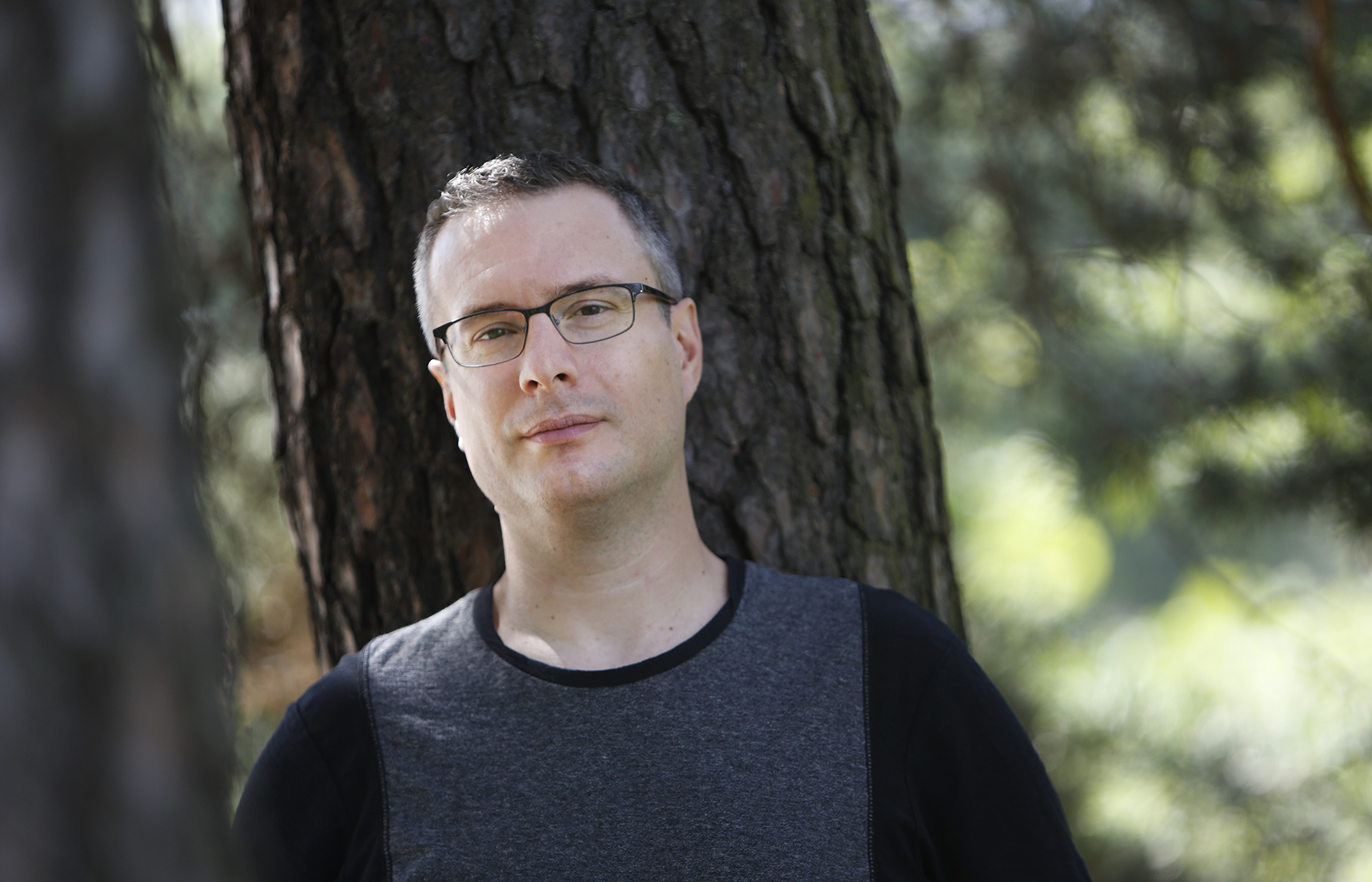
The music of Matthew Whittall often takes extra-musical phenomena and narratives as its starting point, and nature has always been an important source of inspiration for him. Indeed, it is considerably harder to find a Whittall work — whether vocal or purely instrumental — whose title does not in someway allude to nature than one that does.
Requiem for a tree
One of the dilemmas that many composers who have tackled the apocalyptic scenario we currently face must inevitably confront is this: what is the best way to avoid tired, lazy solutions and a hectoring, moralising tone?
For instance, the Swedish composer Mikael Karlsson and his librettist Royce Vavrek resolved this in their song cycle So We Will Vanish, written for Anne Sofie von Otter, by giving voice to three trees, each of which met its demise in different ways and at different times. The same device proves effective in Whittall’s a cappella work The World Tree, written for the Helsinki Chamber Choir and premiered in November 2025. Here, too, the point of departure was by no means just any old tree. Whittall explains that the planning and compositional process behind the piece were not entirely straightforward.
“I didn’t want to produce simply yet another contribution to the climate debate. My original idea was to write some kind of nature-related work, a setting of an original English text, and back in 2019 I contacted the English writer Robert Macfarlane, whose natural-philosophical works I have long admired. To my great excitement, he was keen on the idea of a collaboration, but then the pandemic came along and a whole array of other things got in the way too, and when we eventually returned to the idea in 2023, the iconic Sycamore Gap Tree on Hadrian’s Wall in Northumberland, England, had recently been illegally felled by a pair of eco-vandals. In light of this, it felt logical to let the piece form a kind of requiem for the tree in particular and man’s often destructive relationship with nature in general. When Macfarlane showed me the first drafts of the text, we quickly realised that the overall piece needed a deeper approach, even if its central idea remained the same.”
Whittall explains that the final version of the text examines and illuminates man’s infinite minuteness in time and space, in contrast to nature, which is eternal. Macfarlane elected to place the tree and its history in a wider context, taking its natural starting point during the Ice Age and culminating in the present day, while constantly looking to the future.
Gradually, humans appear on the scene, and towards the end even the tree is given a voice. At the centre of everything, of course, is the idea of the ‘world tree’, a sacred image common to many mythological traditions, an offshoot of which was the 150-year-old sycamore tree in Northumberland. And it was this constellation of ideas that inspired Whittall to compose his grandest and most ambitious choral work to date.
.jpg)
Direct and refined
Having worked with choirs and choral music throughout his life and still an active choir singer to this day, Matthew Whittall has to date written twenty-one choral works of varying scope and style, and he says that The World Tree should be seen as the great synthesis of his activities and aspirations within the genre hitherto.
“I have written modernist music for amateur choirs and, as in this piece, relatively traditional music for professionals. Of course, it is always about finding the optimal means of interpreting and communicating the text at hand. The choral works of Einojuhani Rautavaara and the Estonian Cyrillus Kreek have long been central sources of inspiration for me, as have certain post-minimalist approaches and objectives.”
There are two aspects of contemporary choral music that have long troubled me, both as a critic and as an active choral singer of many years’ standing. First is the fact that even renowned and acclaimed composers so regularly write such ill-sounding and wholly unidiomatic music for choirs for the simple reason that they are not well enough acquainted with the instrument. Secondly, a prevailing feature of Anglo-Saxon and Baltic choral music, though increasingly prevalent in the Nordic countries too, is a phenomenon one might call ‘new simplicity’, an aesthetic that is soft on the ears but all too often banal and predictable.
In this case, however, there is no need to worry about such pitfalls. Whittall knows the choral idiom inside out, and even if his music can seem relatively direct and easy to listen to, it is bursting with a highly personal and exceptionally refined voice, both with regard to the details and larger structural concerns.
Harmony as cornerstone
“I like complexity, but it doesn’t have to be in your face. Overall, The World Tree sticks to a rather traditional texture. The act of breathing is slow, the tone isn’t always consciously declamatory, and the whole approach is in many ways symphonic, even if structurally the work more closely resembles a song cycle. My friend, the composer Alex Freeman noted that the first fortissimo only appears fifteen minutes into the piece, which is a feature of symphonism versus smaller-scale song form.”
It is true that, in this piece, Whittall largely avoids modernist choral clichés, and when they do occur — the most advanced examples being some whispered passages, a brief episode of overtone singing and wind-like sound effects — they are very much dictated by and arise naturally from the text.
Stylistically, Whittall’s music has always been hard to categorise, though a characteristic feature of his aesthetic is often a kind of post-minimalist colouring, taking what might, at the risk of generalisation, be described as a distinctly North American sense of repetition as one of its primary stylistic devices. However, this is not particularly prominent in The World Tree, where what chiefly appeals to me are the exquisitely crafted, finely balanced and emotionally charged harmonic progressions running through the work. Whittall readily agrees.
“Harmony is the cornerstone of the whole piece. For the most part, the music rests on a stable tonal foundation, even though a more modal language comes to the fore from time to time. I make extensive use of triads and tetrachords with added notes, and in this respect the organ symphony JOY and the recent choral works Songs of Travel and The Geography of Hope are the closest immediate relatives of The World Tree.”
In summation, one could say that in The World Tree Whittall succeeds in achieving a considerable freshness with relatively simple and distinctly unsensationalist means. He cites John Williams, William Walton and Francis Poulenc — as it happens, three of my own favourite composers — as important models, and his attempt to create orchestral effects in the context of an a cappella choral work have undeniably borne fruit.
Static harmonic landscape
Ten movements with a total duration of nearly seventy minutes may seem like overkill for an a cappella work, yet the work as a whole is constructed with such skill in terms of both texture and atmosphere that any hint of longueur is conspicuously absent. Macfarlane’s text, which effortlessly shifts from straightforward prose to a distinctly lyrical mode of address, calls for richly varied musical trappings, something that Whittall assiduously realises in his setting.
“Interestingly enough, with its static harmonic landscape, the first movement (Glacial Maximum) was the most challenging to hew out, both in temporal and musical terms. In the expansive second movement (Wildwood) I put a solo quartet (the human voice) against the trees in their expansion northwards, while the third movement (Pollen Polyphony) serves as an airy intermezzo with grains of pollen floating around both in the text and the music.”
Whittall considers the fourth movement (Song of the Axe), in which humans are introduced once and for all, a kind of folk hymnal, while the fifth movement (Lament of the Legionary’s Wife) is an aria, a classical lamentoso that simultaneously provides the first hints of the impending tragedy. The turbulent sixth movement (Night of the Big Wind) offers a necessary expressive contrast to the more introverted atmosphere of the previous movements. Whittall explains that the following movement (Axis Mundi) plays a key role in the overall form.
“It is a litany in which the tree’s whole life cycle is presented in the space of nine minutes. Important stylistic starting points here were the Latin motet, the English part song and even the chants of Hildegard von Bingen. The eighth movement (Heartwood), in which the tree itself speaks, was actually the first one I composed, and as such it serves as a ‘heartwood’ for the whole cycle.”
.jpg)
The forest sings
The ninth movement (Requiem) is the actual requiem, in which Macfarlane incorporates fragments of social-media responses posted in the immediate aftermath of the tree’s felling. Musically, this is the closest this piece comes to a post-minimalist aesthetic where even silence is given the space it needs. But Whittall and Macfarlane did not want to end the piece in a mood of such utter despair.
“We wanted to offer a sense of hope for the future, so the tenth movement (The Word for World is Forest) is a hymn to human reason which hopefully one day will be allowed to prevail. This could still happen if certain fundamental values and perspectives are once again elevated in a way that should always have been self-evident.”
At the end, most of the singers walk off-stage, whispering names of the forest’s often age-old root- and branch-bearing inhabitants. Here, it is the forest itself that sings: “And the forest sings, the forest sings…”. For our own sake, we would do well to listen very carefully to what it has to say.
Translation David Hackston
Featured photo Maarit Kytöharju