%20(1).jpg)
Once upon a time, Europe was divided into two geopolitical systems. From the late 1940s to the early 1990s, the Eastern bloc relied on the Soviet communist system of state ownership, whereas the Western bloc operated on liberal democracy and market economy. Relations between the blocs were often so tense that the era became known as the Cold War.
Yet even amid political and ideological hostility attempts were made to break the ice. Music, in particular, played an important role in creating connections across the “Iron Curtain.” Cultural diplomacy frequently revolved around music. The activities, however, were usually short-lived: individual musicians and state orchestras crossed the borders, gave concerts and tours, and then returned to their home countries.
There was one notable exception: the radio programme Melody Bridge.
Known as Helisild in Estonian and Sävelsilta in Finnish, this special co-venture between Eesti Raadio and Yleisradio was launched in 1966. Broadcast live twice a year, it offered an entertaining musical exchange between the neighbouring countries. The long-running music programme continued until 1990, ending around the time when the Soviet system collapsed.
Preparing the radio bridge
Melody Bridge was a unique attempt to create musical connections between two different realities. At the time, Estonia (officially the Estonian Soviet Socialist Republic) belonged firmly to the Eastern bloc. Finland, pursuing a policy of Cold War neutrality, occupied a space between East and West, yet it remained a Western democracy.
Finland's ambivalent position was reflected, for instance, in the broadcasting world. Broadcasting companies in Europe had abundant cooperation with each other yet operated within separate realms. The European Broadcasting Union (EBU) functioned in the West and the International Radio and Television Organisation (OIRT) in the East. Remarkably, Yleisradio was the only broadcaster that was a member of both unions.
Melody Bridge did not appear out of thin air. Eesti Raadio and Yleisradio had already collaborated on classical art music in the 1930s. Activities took a break during and after the Second World War, but once relations between Finland and the Soviet Union warmed, and after the regular ferry connection between Helsinki and Tallinn reopened in 1965, the radio companies dared to propose a musical reunion.
Crucially, Moscow did not object. Designing and controlling all aspects of Soviet cultural diplomacy, including that of Estonia, the Communist Party gave the green light to the project. With this major obstacle removed, the radio bridge could begin to take shape. Technology posed no problem: separated by a narrow sea gulf, Estonia and Finland formed a geographically perfect pair for a bilateral FM radio show.
Sounds reassuring
The timing was perfect – and so was the naming. In Finland, at least, every time politicians or the media executives discussed the relations with the neighbours, the talk was marinated with metaphors of bridges and bridging. The first official Helisild – Sävelsilta concert was organised by Eesti Raadio. It took place in Kadriorg Park in Tallinn on 19 June 1966. Two months later, Yleisradio hosted the second concert at the Linnanmäki amusement park in Helsinki.
The concept of the radio programme was clear almost from the very beginning and remained virtually unchanged over the years. Every summer, a co-scheduled live concert was held somewhere in Estonia, followed by another in Finland. Featuring soloists from both countries, the programme lasted two hours. The performers were usually accompanied by a large orchestra, and when an Estonian soloist appeared on stage, the conductor came from Finland, and vice versa.
The soloists typically performed entertainment and schlager music, but also mainstream jazz and traditional music. Some singers, such as Heli Lääts and Georg Ots from Estonia and Katri Helena and Georg Malmstén from Finland, were widely known in their home countries. Occasionally, opera arias were performed by artists such as Tiit Kuusik and Margarita Voites from Estonia and Jorma Hynninen and Anita Välkki from Finland. The programme also featured smaller jazz, dance and folk ensembles, as well as choirs and brass bands.
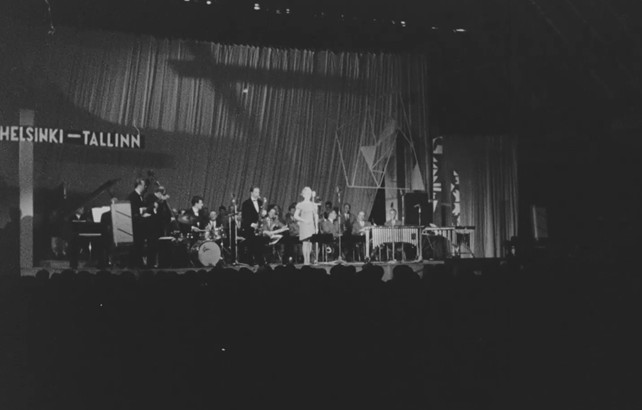
Overall, the musical style of the programme was conventional. The emphasis was on professionally performed feel-good music that suited the ideals of family entertainment and echoed the needs of bloc diplomacy. As a result, neither aggressive nor experimental performances were heard. Modern styles of popular music, including Western pop, rock and disco, were also excluded, as they were viewed as questionable products of the capitalist music industry.
Friendly rivalry
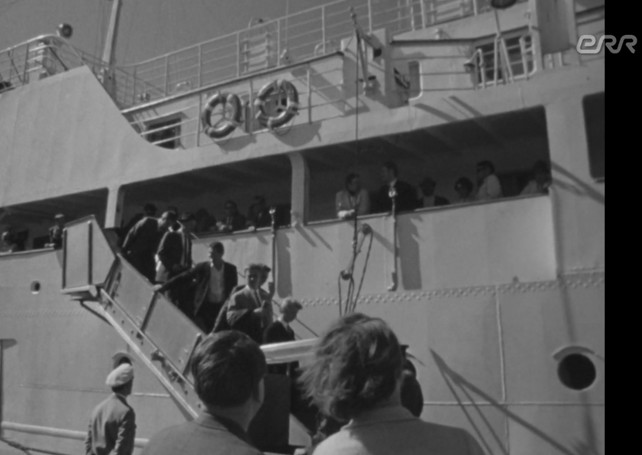
The lack of inventions did not mean a lack of investment. At the early stage, the Estonian and Finnish orchestras took the ferry and travelled across the Gulf of Finland to perform in the neighbouring country. The radio companies soon concluded, however, that this practice was too expensive. It eventually became standard that the hosting country would provide the orchestra.
During the Cold War, competition between East and West permeated many aspects of life. The rivalry inevitably found its way into Melody Bridge as well.
Eesti Raadio was more willing than Yleisradio to invest in music design. When the Estonian Radio Variety Orchestra took the on-air stage in Estonia, it typically consisted of around thirty musicians. It could perform big band music, dance and schlager numbers, light entertainment pieces and classical art music. When necessary, director Peeter Saul could reorganize the orchestra into a swinging jazz combo.
In Finland, Yleisradio assembled freelance musicians and hired prominent bandleaders such as Rauno Lehtinen to facilitate the music programme. Envious of Eesti Raadio’s stronger musical resources, Lehtinen lamented that the Finnish orchestra was too small for him to write ambitious – or even decent – arrangements for the performances.
What was significant about the programme was its ability to create living connections and genuine exchanges between musicians. Some performers, including the conductor Eri Klas, used the programme as a platform for future collaborations with Finnish musical life.
The programme also fostered cooperation among staff within the two radio organisations. Articulating aspects of togetherness in their talk, radio announcers such as Oke Jokinen from Finland and Ivar Trikkel from Estonia played an important role in the diplomacy project. Thus, attention was paid not only to the music itself but also to how the performances were framed.
Echoes of the bridge
The naivety and optimism of Melody Bridge did not endure. The final Helisild – Sävelsilta programme was broadcast in 1990, by which time the structure of the bridge had been crumbling for years. The programme had become a prison of its static format and clichéd style – almost as a radiophonic reflection of the Soviet collapse itself.
No one paid attention when the Melody Bridge fell.
No one seems to miss it today, either. At present, there are no signs that the bilateral melody-bridge format will return to Northern Europe or elsewhere. This is not to say that the days of music diplomacy are over. Some initiatives, most notably the West-Eastern Divan Orchestra, with its commitment to fostering dialogue between Israelis and Palestinians, still try to carry the torch.
In any case, the vocabulary echoing the days of Cold War music diplomacy is far from dead. Music performers and event organisers everywhere keep emphasising the familiar idea of border-crossing friendship. Bridging gaps with music never goes out of fashion.
Sources
Maija Dahlgren, Tapio Lipponen & Kari Vanhapiha (eds.). 1995. Studio Kymppi esittää: Ristivetoa Kankkulassa. Juva: WSOY.
Juha Henriksson. 2010 Toiset meistä. Rauno Lehtinen ja musiikki. Helsinki: JAPA.
Eri Klas. 2002. Eri estradeilla. Finnish translation by Jouko Vanhanen. Helsinki: Otava. The original title (1999) Kes ma olen?
Simo Mikkonen & Pekka Suutari (eds.). 2016. Music, Art and Diplomacy. East-West Cultural Interactions and the Cold War. Ashgate: Farnham & Burlington.
Sävelsilta programmes. the Metro database, the Yle Archive. Yleisradio.
Helisild – Sävelsilta logo from the Yle and ERR archives. Published with permission.